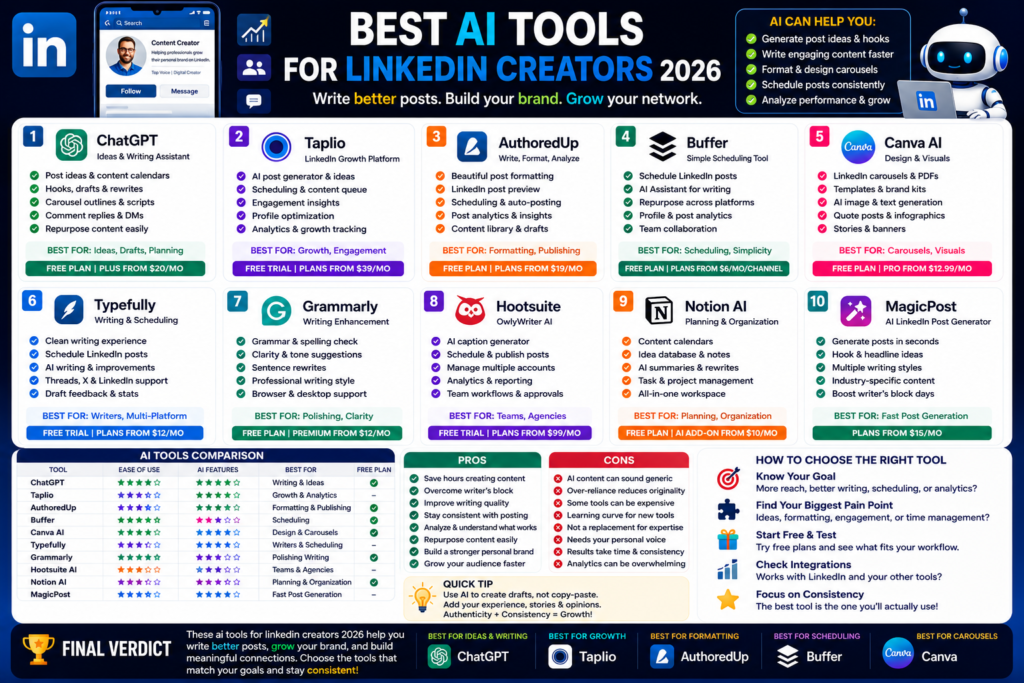
Best AI Tools for LinkedIn Creators 2026
Best AI Tools for LinkedIn Creators 2026: Write Better Posts, Grow Your Brand, and Save Time...
Quick Answer:
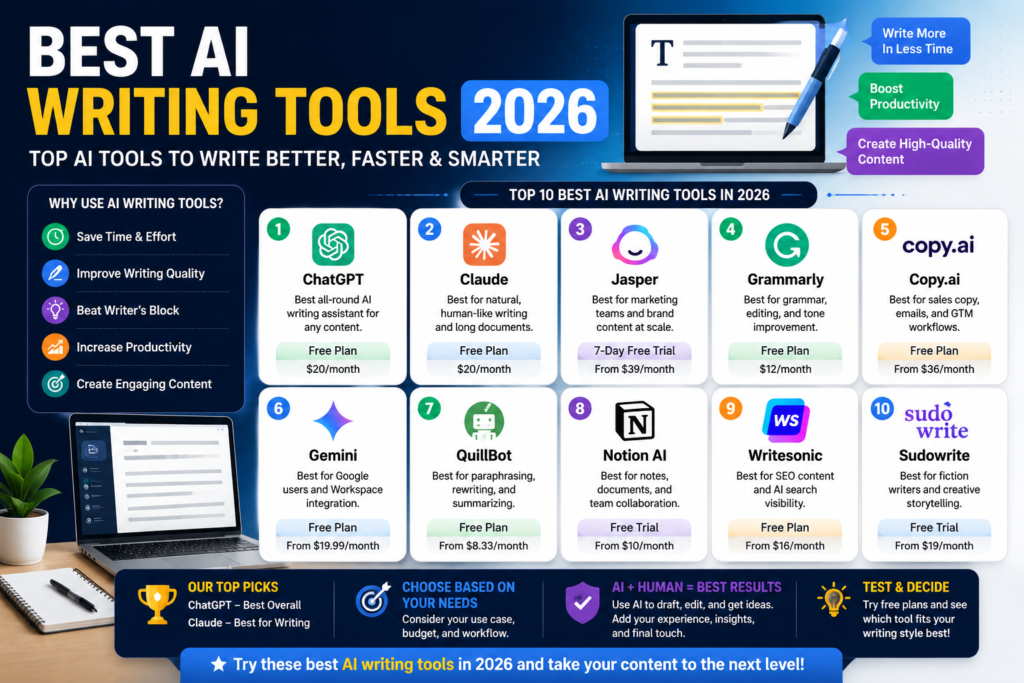
The best AI writing tools 2026 are ChatGPT, Claude, Jasper, Grammarly, Copy.ai, Gemini, QuillBot, Notion AI, Writesonic, and Sudowrite. ChatGPT is best overall, Claude is best for natural writing, Jasper is best for marketing teams, and Grammarly is best for polishing everyday writing.
The best AI writing tools 2026 are not just for bloggers anymore.
A few years ago, most people used AI writing tools to create quick blog drafts or social media captions. Now, these tools help with emails, SEO content, sales pages, newsletters, product descriptions, research notes, scripts, resumes, fiction, and even full marketing workflows.
Honestly, I think AI writing has become normal now. Not perfect. But normal.
Here is the thing. A good AI writing assistant does not replace your brain. It helps you move faster. It gives you structure when you’re stuck. It helps you rewrite messy ideas into something clear.
But not every tool is made for the same person.
Some AI writing software is better for bloggers. Some is better for students. Some is made for business teams. Some is only good for grammar and editing. And some tools are better for creative writing than SEO content.
So in this guide, I’ll keep it simple. No hype. No robotic review style. Just a practical look at the AI writing tools that are actually worth testing in 2026.
Before we jump into the list, let’s talk about what actually matters.
Because “AI writing tool” can mean a lot of things.
First, the output needs to sound natural.
If a tool gives you stiff, generic, boring content, it is not very useful. You’ll spend more time fixing the content than writing it yourself.
A good AI writing tool should help with:
In my experience, the best tools are not always the ones with the most features. They are the ones that help you write better without making everything sound fake.
You also need to choose based on your real work.
For example, a blogger needs SEO outlines, title ideas, FAQs, and long-form drafts.
A student needs summaries, explanations, and essay support.
A business owner needs emails, proposals, landing page copy, and customer replies.
A fiction writer needs story ideas, scenes, dialogue, and character help.
That is why one tool cannot be the best for everyone.
Pricing matters too.
Some tools have strong free plans. Others are expensive but better for teams.
ChatGPT Plus is listed at $20/month and gives enhanced access to ChatGPT. Claude Pro is also listed at $20/month, or $17/month with annual billing.
For most users, around $20 per month is the sweet spot. More than that only makes sense if the tool saves you serious time or money.
Now let’s go through the tools.
ChatGPT is still my top pick overall.
It is not only an AI writing assistant. It can help with brainstorming, editing, SEO outlines, blog posts, emails, scripts, product descriptions, coding, research, and file analysis.
The best thing about ChatGPT is flexibility.
You can use it for almost anything:
ChatGPT Plus includes advanced reasoning, expanded messages and uploads, image creation, deep research and agent mode, memory, projects, tasks, and custom GPTs.
Honestly, if you only want one AI writing tool, start with ChatGPT.
It may need editing, but it gives you the most complete writing workflow.
Claude is one of the best AI writing tools if you care about tone.
In my experience, Claude often sounds more natural than many other chatbots. It is calm, clear, and less salesy.
Claude is very good for:
Claude’s free plan includes writing, editing, content creation, web search, memory across conversations, file creation, code execution, and connectors. Claude Pro adds more usage, Claude Code, Claude Cowork, Research, more models, and Microsoft 365/Outlook support.
If your main goal is human-sounding writing, Claude is one of the strongest choices.
Jasper is built more for marketing than casual writing.
It is useful for businesses that need brand voice, campaign content, ads, landing page copy, email campaigns, and marketing workflows.
Jasper says it is purpose-built for marketing and focuses on AI agents for end-to-end marketing workflows. Its pricing page also mentions Pro and Business plans, plus a 7-day free trial for the Pro plan.
Jasper is not the cheapest option.
But for marketing teams, agencies, and brands, it can make sense.
Use Jasper if you need:
For a solo blogger, ChatGPT or Claude may be enough. For a marketing team, Jasper feels more professional.
Grammarly is still one of the best tools for polishing writing.
It is not always the best tool for creating a full article from scratch. But for editing, grammar, tone, clarity, and rewriting sentences, it is very useful.
Grammarly describes itself as an AI-powered writing assistant that can help with ideas, outlines, emails, reports, articles, and more. Its free plan includes mistake-free writing, tone checks, and 100 AI prompts, while Pro includes sentence rewrites, tone adjustment, brand style help, and 2,000 AI prompts.
I think Grammarly is best for people who write daily.
Use it for:
It catches the small mistakes you miss when you’re tired.
Copy.ai started as a simple AI copywriting tool, but now it is more focused on go-to-market workflows.
That means it is built for sales, marketing, content operations, and business automation.
Copy.ai describes itself as a GTM AI platform and says its workflows combine research, content generation, and tool integrations.
This makes it useful for:
Honestly, Copy.ai may be too much if you only need blog posts.
But if you are running sales or marketing at scale, it is worth testing.
Gemini is a strong option if you already use Google tools.
It can help with writing, planning, brainstorming, research, and productivity. Google describes Gemini as an AI assistant for writing, planning, brainstorming, and more.
The big advantage is Google integration.
Google AI plans include Gemini in Gmail, Docs, Slides, Sheets, and Meet, depending on the plan and availability.
That makes Gemini useful for:
If you live inside Google apps, Gemini is very practical.
For pure writing quality, I still prefer Claude or ChatGPT. But for Google users, Gemini is a smart choice.
QuillBot is best known for paraphrasing.
It helps rewrite sentences, improve fluency, check grammar, analyze tone, summarize content, and avoid accidental plagiarism.
QuillBot describes its suite as AI tools for paraphrasing, grammar checking, tone analysis, fluency, and more. Its Premium plan includes unlimited paraphrasing, unlimited modes, advanced grammar recommendations, humanize features, custom summaries, AI Detector access, and plagiarism prevention.
This tool is great if you already have content and want to improve it.
Use QuillBot for:
I would not use QuillBot as my main blog writing tool. But as a rewriting tool, it is strong.
Notion AI is best if you already use Notion.
It helps you write, summarize, organize ideas, generate documents, and autofill databases inside your workspace.
Notion’s free plan includes a trial of AI capabilities like generating docs and autofilling databases. Notion also describes its AI product as helping users generate docs and work inside Notion’s connected workspace.
Notion AI is useful for:
The truth is, Notion AI is not the best standalone AI writer.
But if your notes, tasks, and content planning already live in Notion, it feels very convenient.
Writesonic used to be known mainly as an AI writing tool.
Now, it has moved strongly toward SEO, AI search visibility, content refreshes, and brand tracking across search and AI platforms.
Writesonic describes itself as an AI Search Visibility Tracking and Optimization Platform that tracks SEO rankings, AI citations, content creation, refreshes, and distribution.
This makes it useful for:
If your main goal is writing simple emails, Writesonic may be more than you need.
But if you care about SEO content and AI visibility, it is worth looking at.
Sudowrite is different from the other tools.
It is made for fiction and creative writing.
Sudowrite calls itself an AI writing partner for fiction and highlights story-focused writing support. Its writing tools support authors through drafting, Story Bible, rewriting, and fiction-focused workflows.
This is not the tool I would pick for SEO blogs.
But for novelists, short story writers, and creative writers, Sudowrite is one of the most interesting options.
Use it for:
If you write fiction, Sudowrite deserves a test.
| Tool | Best For | Free Plan | Paid Value | Best User |
|---|---|---|---|---|
| ChatGPT | All-round writing and productivity | Yes | Excellent | Bloggers, students, freelancers |
| Claude | Natural writing and long documents | Yes | Excellent | Writers, researchers, professionals |
| Jasper | Marketing campaigns | Trial | Strong for teams | Agencies and marketing teams |
| Grammarly | Grammar and editing | Yes | Strong | Everyday writers |
| Copy.ai | Sales and GTM workflows | Varies | Strong for teams | Sales and marketing teams |
| Gemini | Google Workspace writing | Yes | Strong for Google users | Gmail and Docs users |
| QuillBot | Paraphrasing and rewriting | Yes | Good | Students and editors |
| Notion AI | Notes and workspace writing | Trial | Good inside Notion | Teams and planners |
| Writesonic | SEO and AI search visibility | Varies | Good for SEO teams | Marketers and agencies |
| Sudowrite | Fiction writing | Trial | Good for authors | Novelists and storytellers |
AI writing tools can save a lot of time.
They help you:
In my experience, the biggest benefit is momentum.
A blank page feels heavy. AI gives you a starting point.
AI writing tools also have problems.
They can:
Here is the thing. AI writing is not “done” writing.
It is assisted writing.
You still need to check facts, add personal experience, edit the tone, and make the final content sound like you.
AI writing tools are useful for almost anyone who writes regularly.
Bloggers can use AI for outlines, intros, FAQs, meta descriptions, title ideas, and content updates.
For SEO content, ChatGPT, Claude, Jasper, Writesonic, and Gemini are strong choices.
But don’t just publish raw AI content. Add examples, screenshots, opinions, comparisons, and real testing.
Students can use AI to understand topics, summarize notes, improve essays, and create study guides.
Professionals can use AI for emails, reports, meeting notes, proposals, and presentations.
For this group, Grammarly, Claude, ChatGPT, QuillBot, and Notion AI are especially useful.
Businesses can use AI writing tools for customer replies, sales emails, marketing campaigns, internal documents, product descriptions, and SOPs.
For teams, Jasper, Copy.ai, Grammarly, Notion AI, and Gemini can be strong choices.
ChatGPT is the best overall AI writing tool in 2026 because it works well for blogs, emails, SEO content, scripts, research, file analysis, and everyday writing tasks.
Claude often sounds the most natural for long-form writing. It is especially good for thoughtful articles, reports, emails, and document editing.
ChatGPT, Claude, Gemini, Grammarly, and QuillBot all offer useful free options. The best one depends on whether you need drafting, editing, paraphrasing, or Google app support.
Yes, AI writing can help with SEO, but only if you edit properly. Use AI for outlines, FAQs, meta descriptions, and content ideas. Then add real experience, accurate facts, and helpful examples.
No, not completely. AI writing tools can speed up drafts and editing, but good writers still add judgment, voice, examples, research, and emotional understanding.
So, which tool should you choose?
Here is my honest answer.
If you want the best overall tool, choose ChatGPT.
If you want the most natural writing, try Claude.
If you run marketing campaigns, test Jasper.
If you need grammar and editing help, use Grammarly.
If you write fiction, try Sudowrite.
The truth is, there is no single perfect tool for everyone. The best choice depends on your workflow, budget, and writing style.
My advice is simple. Pick two tools and test them for one week. Use them for real work, not random prompts. Write emails, outlines, blog posts, summaries, and edits.
That is the only way to know what actually helps.
For more practical reviews like this best ai writing tools 2026 guide, keep reading AI Daily Tool for honest AI tool comparisons, beginner guides, and real-world recommendations.
Best AI Tools for LinkedIn Creators 2026: Write Better Posts, Grow Your Brand, and Save Time...
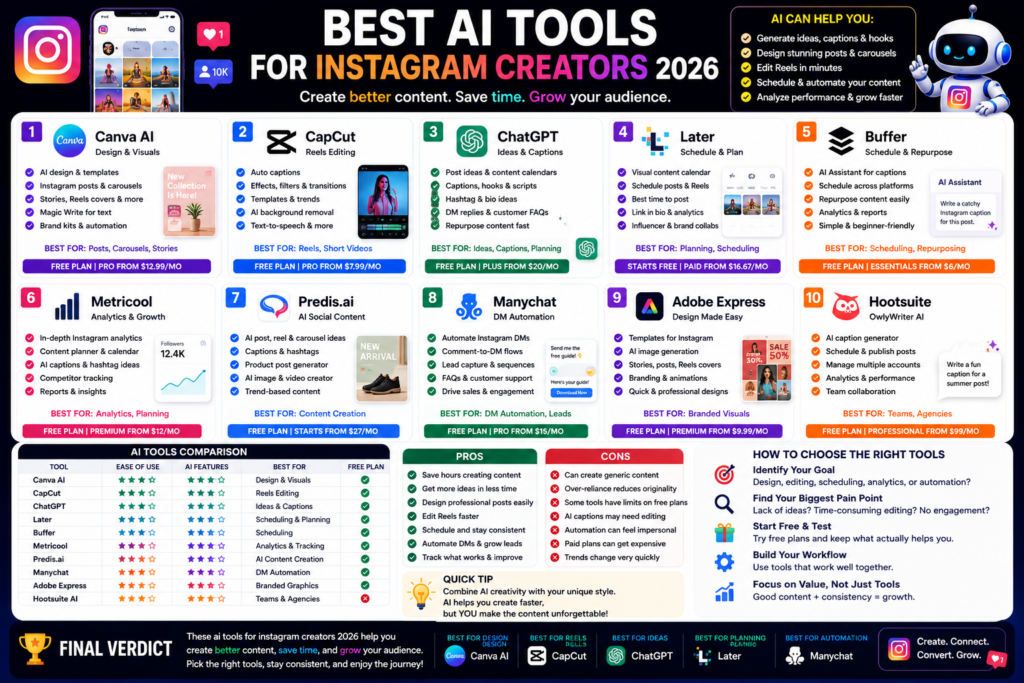
Best AI Tools for Instagram Creators 2026: Create Better Posts, Reels, and Carousels Faster Quick Answer:...
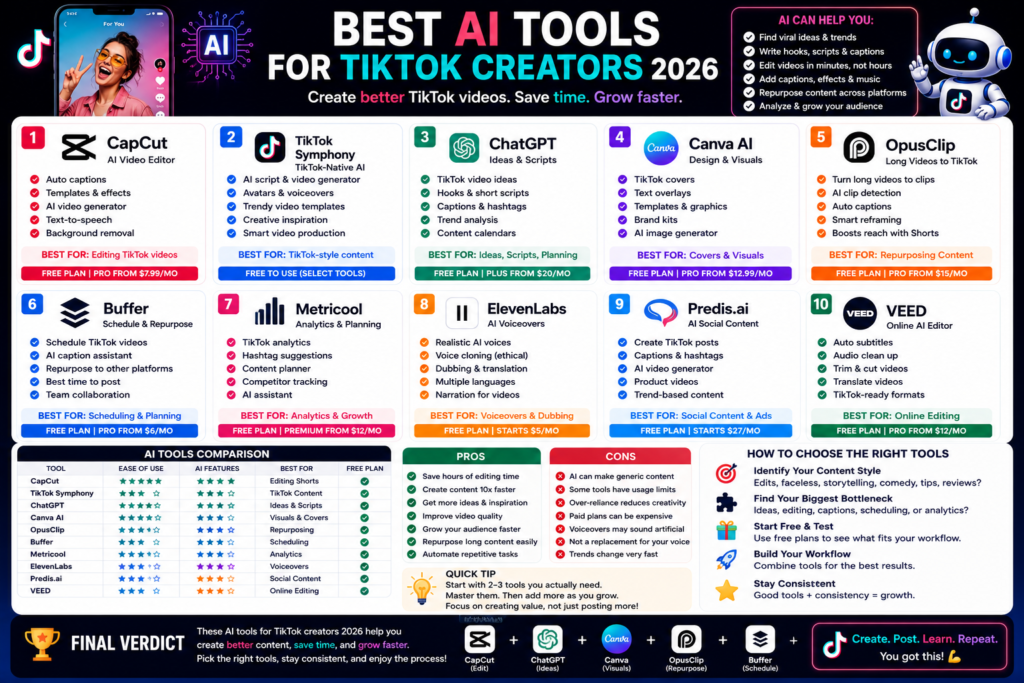
Best AI Tools for TikTok Creators 2026: Create Faster, Edit Smarter, and Grow Your Audience Quick...
Leave a Comment