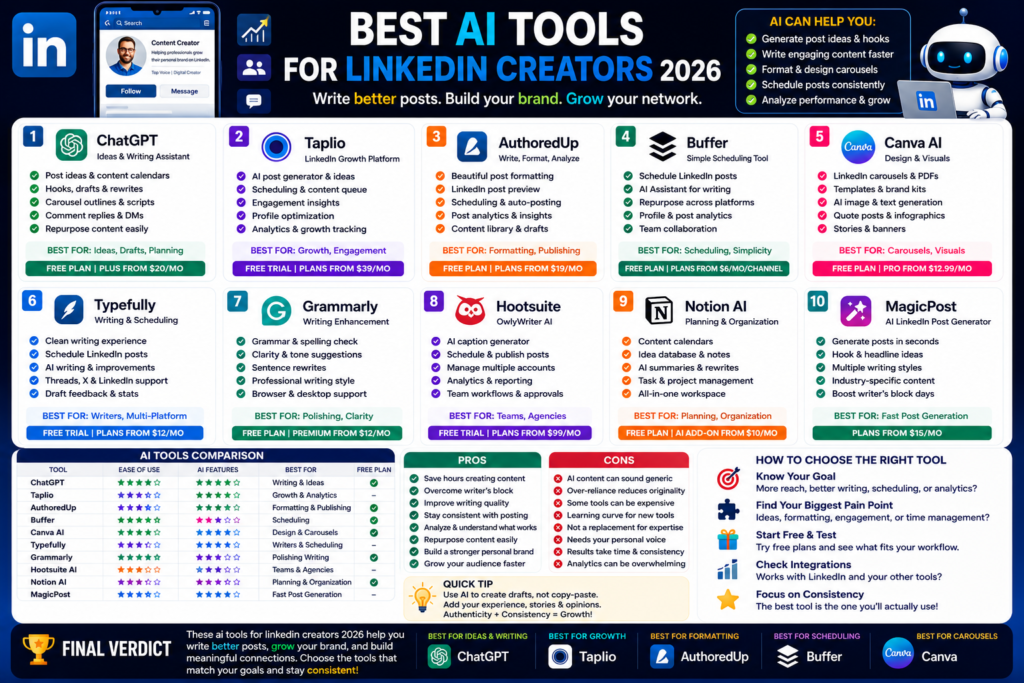
Best AI Tools for LinkedIn Creators 2026
Best AI Tools for LinkedIn Creators 2026: Write Better Posts, Grow Your Brand, and Save Time...
Quick Answer:
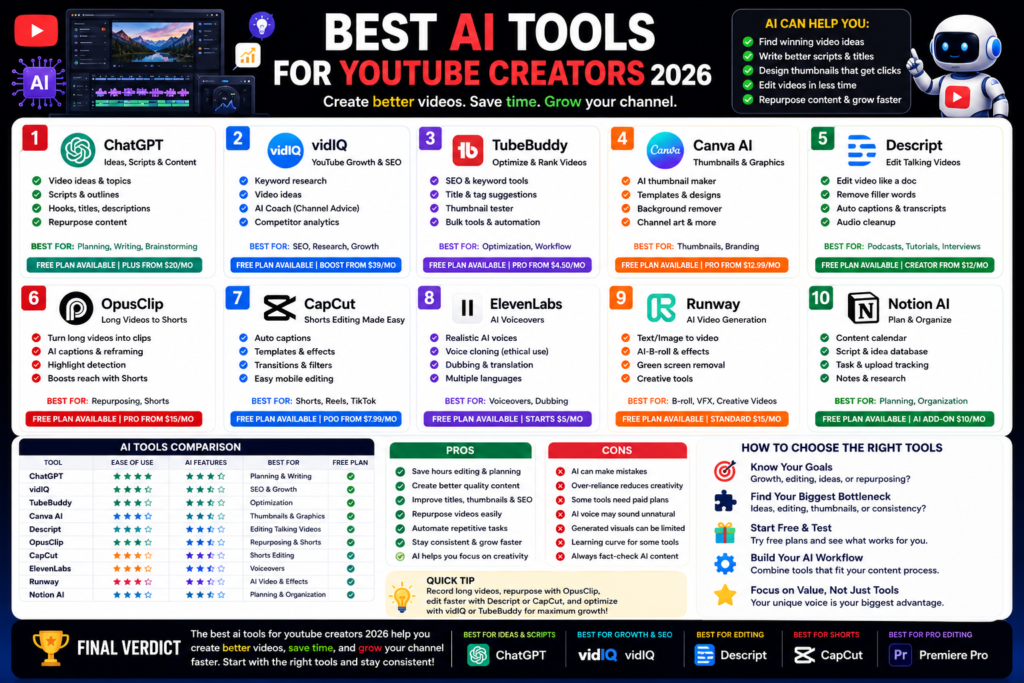
The best ai tools for youtube creators 2026 are ChatGPT, vidIQ, TubeBuddy, Canva AI, Descript, OpusClip, CapCut, ElevenLabs, Runway, and Notion AI. ChatGPT is best for ideas and scripts, vidIQ and TubeBuddy are best for YouTube SEO, Canva is best for thumbnails, Descript is best for editing, and OpusClip is best for turning long videos into Shorts.
The best ai tools for youtube creators 2026 can make YouTube content creation much easier.
And honestly, YouTube is not simple anymore.
You need video ideas, strong titles, thumbnails, scripts, editing, captions, Shorts, descriptions, tags, analytics, comments, repurposing, and consistency.
That is a lot for one creator.
AI tools can help with the boring and time-consuming parts.
They can help you find video ideas, write scripts, improve titles, create thumbnails, edit videos, generate captions, clean audio, turn long videos into Shorts, create voiceovers, and organize your content calendar.
Here is the thing.
AI will not make your channel successful by itself.
You still need a good niche, strong storytelling, clear value, good editing, and real audience understanding.
But AI can help you work faster.
And on YouTube, speed matters. If you can create better videos in less time, you have more chances to test ideas, learn from analytics, and improve.
Not every AI tool is useful for YouTubers.
Some tools look exciting but do not solve real creator problems.
A good YouTube AI tool should help with one clear part of the workflow.
YouTube starts with the idea.
A boring idea with a great camera still struggles.
A strong idea with a simple setup can perform much better.
AI tools can help you brainstorm:
This is where ChatGPT, vidIQ, TubeBuddy, and Notion AI can help.
On YouTube, people click because of the title and thumbnail.
Then they stay because of the hook, pacing, story, and value.
AI can help improve:
In my experience, small improvements in title and thumbnail can make a big difference.
That is why tools like Canva, vidIQ, and TubeBuddy are very useful.
Editing is one of the biggest time drains.
AI video tools can help with:
If a tool saves you a few hours every week, it can be worth using.
Here are the top tools I would actually consider for YouTube creators.
ChatGPT is one of the most useful AI tools for YouTube creators.
It can help with almost every planning and writing task.
Best for:
For example, you can ask:
“Give me 20 YouTube video ideas for a beginner finance channel.”
Or:
“Write a 60-second Shorts script about how to save money on groceries.”
Or:
“Turn this video transcript into a YouTube description, pinned comment, and 5 Shorts ideas.”
Honestly, ChatGPT is best when you use it as a creative partner.
Do not just copy and paste everything.
Use it to create options, then add your own experience, examples, and personality.
vidIQ is one of the best AI tools for YouTube growth.
It is built specifically for YouTube creators.
You can use it for keyword research, video ideas, title ideas, channel insights, competitor research, analytics, and AI coaching.
Best for:
The reason vidIQ is useful is simple.
It is focused on YouTube.
ChatGPT can give general advice, but vidIQ is designed around YouTube data and creator workflows.
If you are serious about growing a YouTube channel, vidIQ can help you understand what topics people search for and what your channel should create next.
In my opinion, vidIQ is especially useful for beginners who struggle with topic selection.
TubeBuddy is another strong YouTube growth tool.
It helps creators with titles, tags, keyword research, SEO, thumbnails, publishing workflows, and channel optimization.
Best for:
TubeBuddy is useful if you want to improve your upload process.
A lot of creators make the video and then rush the upload.
That is a mistake.
Your title, description, thumbnail, tags, chapters, and publishing time can all affect performance.
TubeBuddy helps you treat YouTube like a system, not just a place to upload videos.
Canva AI is one of the best tools for YouTube thumbnails.
And thumbnails matter a lot.
People often decide whether to click based on the thumbnail before they even read the full title.
Canva helps you create:
Canva AI can help generate designs, images, text ideas, and thumbnail layouts.
The best part is that Canva is beginner-friendly.
You do not need to be a professional designer.
But here is my honest advice.
Do not make thumbnails too crowded.
Use one clear idea, strong contrast, readable text, and an emotional visual.
A clean thumbnail usually performs better than a messy one.
Descript is excellent for YouTubers who record talking-head videos, podcasts, interviews, tutorials, and educational content.
It lets you edit video and audio like editing text.
That means you can remove words from the transcript and the video changes too.
Best for:
This is very useful if you record long videos.
For example, if you say “um” too much or repeat yourself, Descript can help clean the video faster.
It is not always the best tool for cinematic editing.
But for YouTube educators, podcasters, coaches, and tutorial creators, Descript can save a lot of time.
OpusClip is one of the best tools for repurposing long videos into short clips.
If you create long YouTube videos, podcasts, interviews, webinars, or livestreams, OpusClip can help turn them into YouTube Shorts, TikToks, and Reels.
Best for:
This is a smart creator strategy.
One long video can become:
That gives you more content from one recording.
In my experience, repurposing is one of the easiest ways to grow without creating from zero every day.
CapCut is one of the best tools for YouTube Shorts.
It is easy to use, mobile-friendly, and made for short-form content.
Best for:
CapCut is great for creators who want fast editing without learning professional software.
You can cut clips, add captions, use templates, add music, and export quickly.
If your YouTube strategy includes Shorts, CapCut is worth using.
It is especially useful for beginners.
You do not need a complicated editing setup to start.
ElevenLabs is one of the strongest AI voiceover tools.
It is useful for faceless YouTube channels, explainer videos, documentaries, educational videos, and multilingual content.
Best for:
AI voice tools can save time if you do not want to record your own voice.
But use them carefully.
The voice should sound natural, not fake or spammy.
Also, avoid copying someone’s voice without permission.
That can create trust and policy problems.
For creators, ethical use matters.
Runway is a powerful AI video generation tool.
It is best for creators who want AI-generated clips, cinematic visuals, concept scenes, B-roll, and creative effects.
Best for:
Runway is not necessary for every YouTuber.
If you are making simple talking-head videos, you may not need it.
But if your videos need visual storytelling, cinematic scenes, or creative AI clips, Runway can help.
For example, a history channel, tech channel, storytelling channel, or faceless education channel may use Runway for visual support.
Just remember that AI visuals should support the video, not distract from it.
Notion AI is useful for organizing your YouTube channel.
Many creators fail because their ideas are scattered everywhere.
They have ideas in notes, scripts in Google Docs, thumbnails in Canva, deadlines in their head, and analytics in random screenshots.
That gets messy.
Notion can help you manage:
Notion AI can help summarize notes, create drafts, organize ideas, and turn messy planning into a clear system.
Honestly, if you want to take YouTube seriously, you need a content system.
Notion is great for that.
| Tool | Best For | Free Plan | Best YouTube Use |
|---|---|---|---|
| ChatGPT | Ideas and scripts | Yes | Hooks, scripts, descriptions, planning |
| vidIQ | YouTube growth | Yes | Keywords, ideas, AI coaching |
| TubeBuddy | Optimization | Yes / paid plans | Titles, tags, SEO, upload workflow |
| Canva AI | Thumbnails | Yes | YouTube thumbnails and graphics |
| Descript | Video editing | Yes / paid plans | Talking videos, podcasts, transcripts |
| OpusClip | Repurposing | Yes / credits | Long videos into Shorts |
| CapCut | Shorts editing | Yes | Shorts, Reels, TikToks |
| ElevenLabs | Voiceovers | Yes / paid plans | Narration and dubbing |
| Runway | AI video | Yes / credits | AI B-roll and creative visuals |
| Notion AI | Planning | Yes / paid AI varies | Content calendars and scripts |
AI tools can help YouTubers work faster.
They can:
In my experience, the biggest benefit is consistency.
AI helps you publish more often without burning out.
AI tools also have problems.
They can:
Here is the thing.
AI can help with production, but your channel still needs a real point of view.
People subscribe because they trust your voice, not because you used a tool.
YouTube creators should use AI responsibly.
If your video includes realistic altered or synthetic content that viewers could mistake for real people, places, scenes, or events, you may need to disclose AI use during upload.
This does not mean every AI-assisted video is a problem.
Using AI for scripts, editing help, captions, thumbnails, or brainstorming is normal.
But if you create realistic AI footage, fake events, synthetic people, cloned voices, or deepfake-style content, be careful.
Trust matters.
Always avoid misleading viewers.
Beginners should start simple.
Use ChatGPT for ideas and scripts.
Use Canva for thumbnails.
Use CapCut for editing Shorts.
Use Notion for planning.
That is enough at the start.
Do not buy ten tools before you upload your first video.
Educational creators should use ChatGPT, Claude, Descript, Canva, Notion, and OpusClip.
These tools help with research, scripts, editing, thumbnails, and repurposing.
If you teach something, clarity matters.
AI can help organize your ideas.
Faceless creators can use ChatGPT, ElevenLabs, Runway, Canva, CapCut, and Pictory-style tools.
These help with scripts, voiceovers, visuals, editing, and thumbnails.
But be careful with quality.
Low-effort AI faceless videos are everywhere now.
To stand out, you need better research, better storytelling, and better editing.
Podcasters should use Descript, OpusClip, Canva, ChatGPT, and Notion.
Descript helps edit episodes.
OpusClip turns episodes into short clips.
Canva helps with thumbnails.
ChatGPT helps with titles, show notes, and descriptions.
If you are serious about growth, use a stronger stack.
Try ChatGPT, vidIQ, TubeBuddy, Canva, Descript, OpusClip, and Notion.
This gives you help with ideas, SEO, thumbnails, editing, repurposing, and organization.
The best AI tools for YouTube creators in 2026 are ChatGPT, vidIQ, TubeBuddy, Canva AI, Descript, OpusClip, CapCut, ElevenLabs, Runway, and Notion AI.
ChatGPT is one of the best free AI tools for YouTube creators because it helps with ideas, scripts, titles, descriptions, hooks, and content planning. Canva and CapCut are also great free starting tools.
Canva AI is one of the best tools for YouTube thumbnails because it offers templates, AI design tools, image tools, and easy editing for beginners.
vidIQ and TubeBuddy are two of the best AI-powered tools for YouTube SEO because they help with keywords, titles, tags, video ideas, and channel optimization.
Yes, AI can help grow a YouTube channel by improving ideas, scripts, titles, thumbnails, editing speed, Shorts creation, and consistency. But growth still depends on audience value, watch time, retention, and trust.
The best ai tools for youtube creators 2026 depend on your channel type.
If you need ideas and scripts, use ChatGPT.
If you need YouTube growth data, use vidIQ.
If you need SEO and upload optimization, use TubeBuddy.
If you need thumbnails, use Canva AI.
If you edit talking videos or podcasts, use Descript.
If you repurpose long videos into Shorts, use OpusClip.
If you edit short videos, use CapCut.
If you need voiceovers, use ElevenLabs.
If you need AI B-roll or creative visuals, use Runway.
If you need planning and organization, use Notion AI.
My honest advice is simple.
Start with three tools: ChatGPT, Canva, and CapCut.
That gives you ideas, visuals, and editing.
Then add vidIQ or TubeBuddy when you want better YouTube SEO.
Add Descript or OpusClip when you start creating longer videos.
AI can help you create faster, but your content still needs your personality, value, and voice.
Use AI to save time.
Use your creativity to build the channel.
For more practical guides like this ai tools for youtube creators 2026 article, keep reading AI Daily Tool for honest AI reviews, tool comparisons, and creator-friendly recommendations.
Best AI Tools for LinkedIn Creators 2026: Write Better Posts, Grow Your Brand, and Save Time...
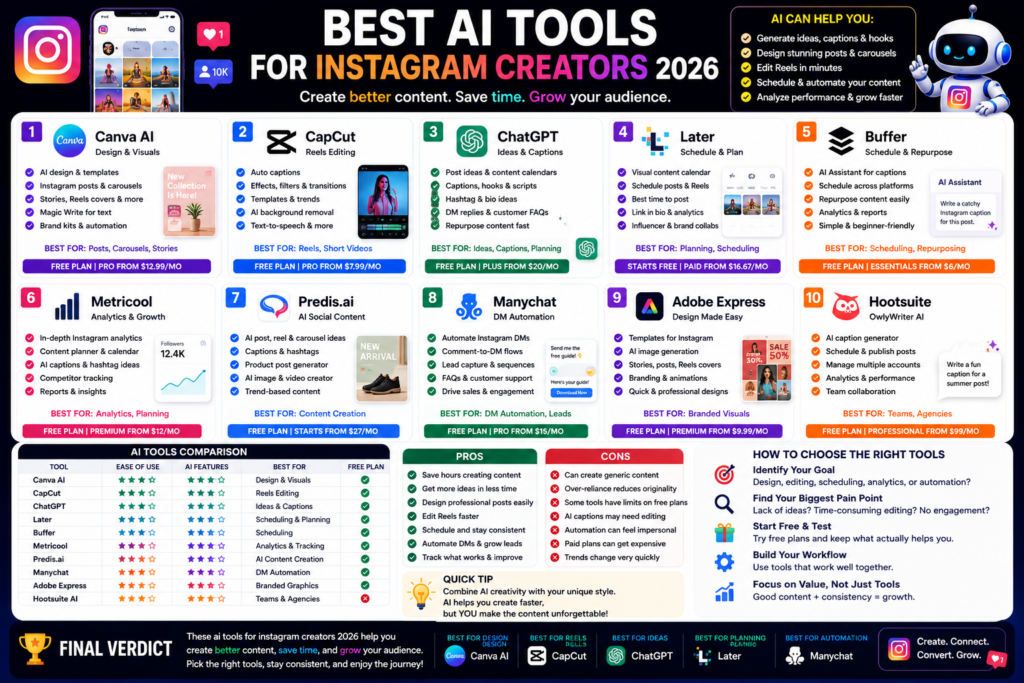
Best AI Tools for Instagram Creators 2026: Create Better Posts, Reels, and Carousels Faster Quick Answer:...
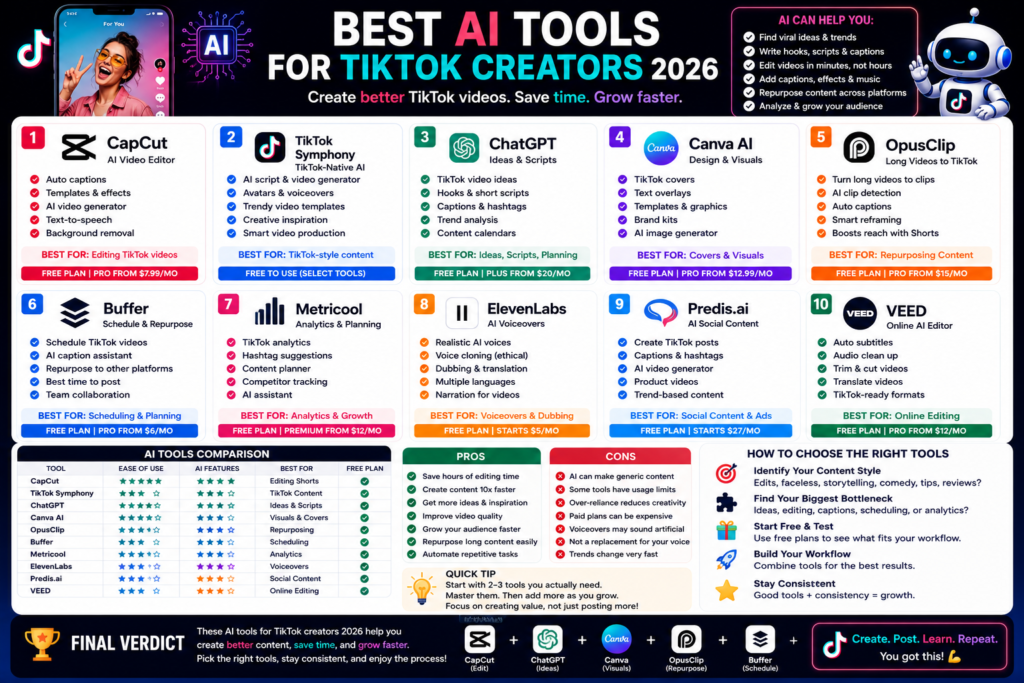
Best AI Tools for TikTok Creators 2026: Create Faster, Edit Smarter, and Grow Your Audience Quick...
Leave a Comment