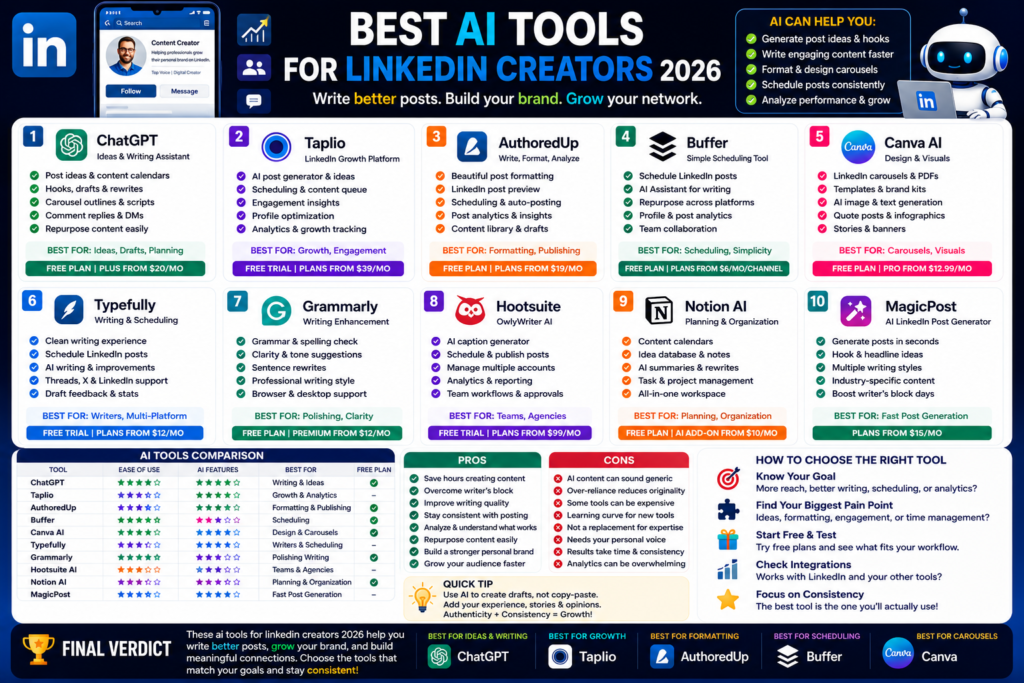
Best AI Tools for LinkedIn Creators 2026
Best AI Tools for LinkedIn Creators 2026: Write Better Posts, Grow Your Brand, and Save Time...
Quick Answer:
The best ai tools small business 2026 options are ChatGPT, Claude, Gemini, Microsoft Copilot, Canva AI, Zapier, HubSpot Breeze, Grammarly, Mailchimp, Shopify Magic, and QuickBooks AI. ChatGPT is best overall, Zapier is best for automation, Canva is best for design, and HubSpot Breeze is best for sales and CRM.
The best ai tools small business 2026 are not just “nice to have” anymore.
They are becoming part of daily business work.
If you run a small business, you already know the problem. You need to write emails, answer customers, create social posts, manage invoices, update your website, follow up with leads, plan content, check reports, and somehow still do the actual work.
Honestly, that is a lot.
AI tools can help with the boring parts. They can write drafts, summarize meetings, create designs, automate repetitive tasks, organize leads, suggest email campaigns, and help you understand numbers faster.
Here is the thing. AI will not magically fix a bad business. It will not replace good customer service, strong offers, or real strategy.
But it can save time.
And for small businesses, time is money.
In this guide, I’ll keep it simple. These are practical small business AI tools for real work, not random tools that sound cool but never get used.
Not every AI tool is good for small business owners.
Some are too expensive. Some are too technical. Some are built for big enterprise teams. And some are just fancy toys.
Small business owners do not have time to spend three weeks learning software.
A good tool should be easy enough for a founder, assistant, marketer, or freelancer to use without needing a developer.
That is why tools like ChatGPT, Canva, Grammarly, Mailchimp, and HubSpot are popular. They solve common problems quickly.
A good AI tool should save time on work you already do.
That could mean:
If the tool does not save time or improve output, skip it.
This is important.
Don’t buy tools just because people on YouTube say they are amazing.
Choose tools that fit how your business already works.
If you use Google Workspace, Gemini makes sense.
If you use Microsoft 365, Copilot makes sense.
If you use Shopify, Shopify Magic makes sense.
If you already use HubSpot, Breeze is worth testing.
Here are the tools I would actually consider for a small business.
ChatGPT is the best all-round AI tool for small business owners.
You can use it for writing, brainstorming, customer replies, blog outlines, proposals, product descriptions, social media captions, SOPs, hiring questions, and business planning.
ChatGPT Business includes features like apps, data analysis, record mode, canvas, shared projects, custom workspace GPTs, user management, admin controls, and security features like SAML SSO and MFA. It also says business data is not used for training by default.
Best for:
In my experience, ChatGPT is the first AI tool most small businesses should try.
Why? Because it is flexible.
You can use it in almost every department.
Claude is great if your business involves a lot of writing, documents, or planning.
It is especially useful for long emails, reports, policies, proposals, client messages, and document summaries.
Claude Pro is listed at $20/month, or $17/month with annual billing, and includes more usage, Claude Code, Claude Cowork, unlimited projects, Research, access to more Claude models, and Microsoft 365 and Outlook support.
Best for:
Honestly, Claude often sounds more natural than many AI tools.
If you care about tone, test Claude.
Gemini is best if your business already uses Google tools.
If your team works in Gmail, Docs, Drive, Sheets, Calendar, and Meet, Gemini can fit into your normal workflow.
Google AI Pro includes higher access to Gemini models, Gemini in Gmail and Docs, 5 TB of storage, NotebookLM benefits, and higher limits in developer tools like Gemini CLI and Gemini Code Assist.
Best for:
The good news is simple. You do not need to move your whole business to a new platform.
Gemini works best where many small businesses already work.
Microsoft 365 Copilot is useful if your team lives inside Word, Excel, Outlook, PowerPoint, Teams, and OneDrive.
Microsoft says Copilot is built for work and helps turn data into insights inside familiar apps. Its business pricing page also says Copilot Chat is available at no additional cost for eligible Microsoft Entra account users with an eligible Microsoft 365 subscription.
Best for:
If your business already pays for Microsoft 365, Copilot is worth checking before buying another AI assistant.
Canva AI is perfect for small businesses that need designs but do not have a full-time designer.
You can create social posts, flyers, presentations, ads, posters, thumbnails, and basic brand graphics.
Canva’s pricing page says its AI tools include features like Canva AI, Translate, Magic Write, and other AI design tools depending on the plan.
Best for:
I think Canva is one of the easiest wins for small businesses.
You can make your business look more professional without hiring a designer for every small task.
Zapier is one of the best AI automation tools for small businesses.
It connects your apps and helps automate repetitive tasks.
Zapier says it connects 400+ AI tools to 9,000+ everyday apps, helps users build AI agents, deploy chatbots, and create workflows in minutes with built-in AI assistance.
Best for:
For example, you can create automations like:
Here is the thing. Zapier is not flashy.
But it can save hours every week.
HubSpot Breeze is useful if you need AI inside your sales and marketing system.
HubSpot says Breeze is its collection of AI tools built into the customer platform to help marketing, sales, and service teams get more done.
Best for:
If your small business already uses HubSpot, Breeze is a natural choice.
It can help your team respond faster, organize leads better, and reduce manual sales work.
Grammarly is still one of the best AI tools for business writing.
It helps with grammar, clarity, tone, rewriting, and professional communication.
Grammarly says it provides personalized AI guidance and text generation across apps and websites.
Best for:
Small mistakes can make a business look unprofessional.
Grammarly helps reduce those mistakes.
It is not the most exciting tool, but it is very practical.
Mailchimp is useful for small businesses that rely on email marketing.
It helps with newsletters, automations, email campaigns, audience segments, and marketing analytics.
Mailchimp’s pricing page lists generative AI features, actionable insights, enhanced automations, and email marketing tools across its plans.
Best for:
If you sell products or services, email is still powerful.
AI can help you create subject lines, draft campaign ideas, and improve messaging faster.
Shopify Magic is great if your small business sells products online through Shopify.
Shopify says Magic is a suite of free AI-powered features integrated across Shopify products and workflows to help users start, run, and grow a business. It supports tasks across store building, marketing, customer support, and back-office work.
Best for:
If you are already using Shopify, start with Shopify Magic before paying for extra AI tools.
It is built into the platform, which makes it easier.
QuickBooks is useful for small business finance, invoicing, expenses, payroll, and cash flow.
QuickBooks says its AI helps automate accounting, financial reporting, customer communications, and other business tasks. It also says AI can help small and mid-sized businesses automate bookkeeping, customer management, and finance tracking.
QuickBooks also says AI tools can help with tasks like categorizing transactions, detecting anomalies, reconciling accounts, and forecasting cash flow.
Best for:
The truth is, finance is one area where small mistakes can cost money.
So AI can help, but always review important numbers yourself or with an accountant.
| Tool | Best For | Free Plan | Best Small Business Use |
|---|---|---|---|
| ChatGPT | Overall productivity | Yes | Writing, planning, support, ideas |
| Claude | Documents and writing | Yes | Proposals, reports, long emails |
| Gemini | Google users | Yes | Gmail, Docs, Drive, research |
| Microsoft Copilot | Microsoft users | Depends on plan | Word, Excel, Outlook, Teams |
| Canva AI | Design | Yes | Social posts, flyers, ads |
| Zapier AI | Automation | Yes | App workflows and AI agents |
| HubSpot Breeze | CRM and sales | Yes / paid features | Leads, sales, support |
| Grammarly | Communication | Yes | Grammar, tone, rewriting |
| Mailchimp | Email marketing | Yes / paid plans | Newsletters and campaigns |
| Shopify Magic | Ecommerce | Built into Shopify | Product pages and store tasks |
| QuickBooks AI | Accounting | Depends on plan | Finance and cash flow |
AI tools can help small businesses move faster.
They can:
In my experience, the biggest benefit is not “AI replacing people.”
The real benefit is that one person can do more without burning out.
AI tools also have problems.
They can:
Here is the thing. AI should assist your business, not run it blindly.
Always check important emails, numbers, contracts, and customer responses before sending or publishing.
If you work alone, start with ChatGPT, Canva, Grammarly, and Zapier.
That gives you writing, design, editing, and automation.
You do not need ten tools on day one.
For plumbers, electricians, repair shops, lawyers, consultants, cleaning companies, and local agencies, the best setup is simple.
Use ChatGPT for content and customer replies.
Use Canva for social posts.
Use HubSpot or Mailchimp for leads and follow-ups.
Use QuickBooks for accounting.
If you run an online store, start with Shopify Magic, ChatGPT, Canva, Mailchimp, and QuickBooks.
That covers product descriptions, design, email marketing, store content, and finance.
For teams, choose tools based on your current stack.
Google team? Use Gemini.
Microsoft team? Use Copilot.
Sales-heavy team? Use HubSpot Breeze.
Operations-heavy team? Use Zapier.
ChatGPT is the best overall AI tool for small business in 2026 because it can help with writing, planning, customer replies, marketing ideas, documents, research, and daily productivity.
ChatGPT, Claude, Gemini, Canva, Grammarly, Zapier, Mailchimp, and Shopify Magic all offer useful free or built-in options depending on your setup and usage limits.
Canva AI is best for design, Mailchimp is best for email marketing, HubSpot Breeze is best for CRM and sales, and ChatGPT is best for content ideas and campaign planning.
Zapier AI is one of the best automation tools for small business because it connects thousands of apps and helps automate workflows without coding.
No, not fully. AI can reduce repetitive work and help people work faster, but it still needs human review, strategy, customer understanding, and good business judgment.
The best ai tools small business 2026 setup depends on your business.
But here is my honest recommendation.
Start with ChatGPT for overall productivity.
Add Canva AI for design.
Use Grammarly for better communication.
Use Zapier to automate repetitive tasks.
Use HubSpot Breeze or Mailchimp for leads and marketing.
Use QuickBooks AI for finance.
Then add Gemini, Copilot, Shopify Magic, or Claude depending on your workflow.
Don’t buy everything at once.
Pick two or three tools. Use them for real tasks for one week. If they save time, keep them. If they create more work, drop them.
That is the smartest way to use AI in a small business.
For more practical guides like this ai tools small business 2026 article, keep reading AI Daily Tool for honest reviews, simple comparisons, and real-world AI recommendations.
Best AI Tools for LinkedIn Creators 2026: Write Better Posts, Grow Your Brand, and Save Time...
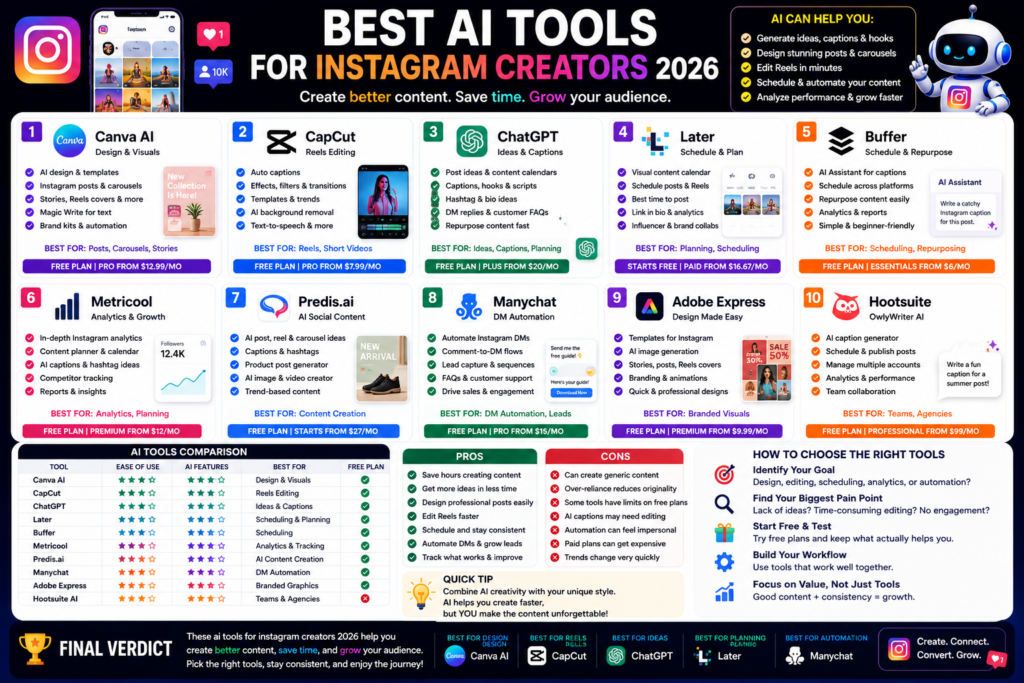
Best AI Tools for Instagram Creators 2026: Create Better Posts, Reels, and Carousels Faster Quick Answer:...
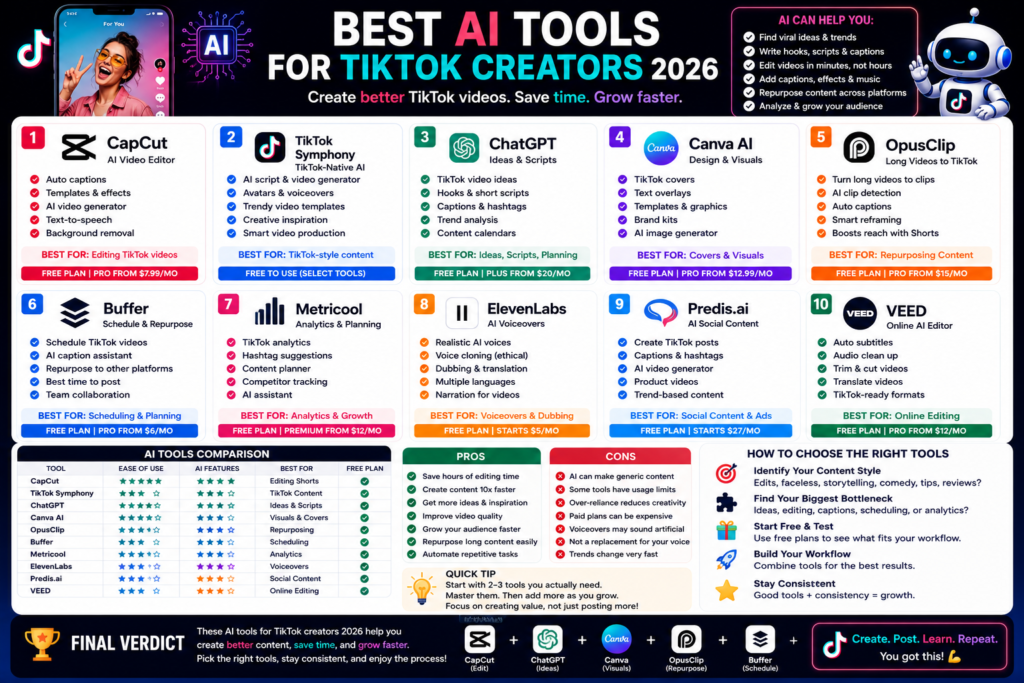
Best AI Tools for TikTok Creators 2026: Create Faster, Edit Smarter, and Grow Your Audience Quick...
Leave a Comment