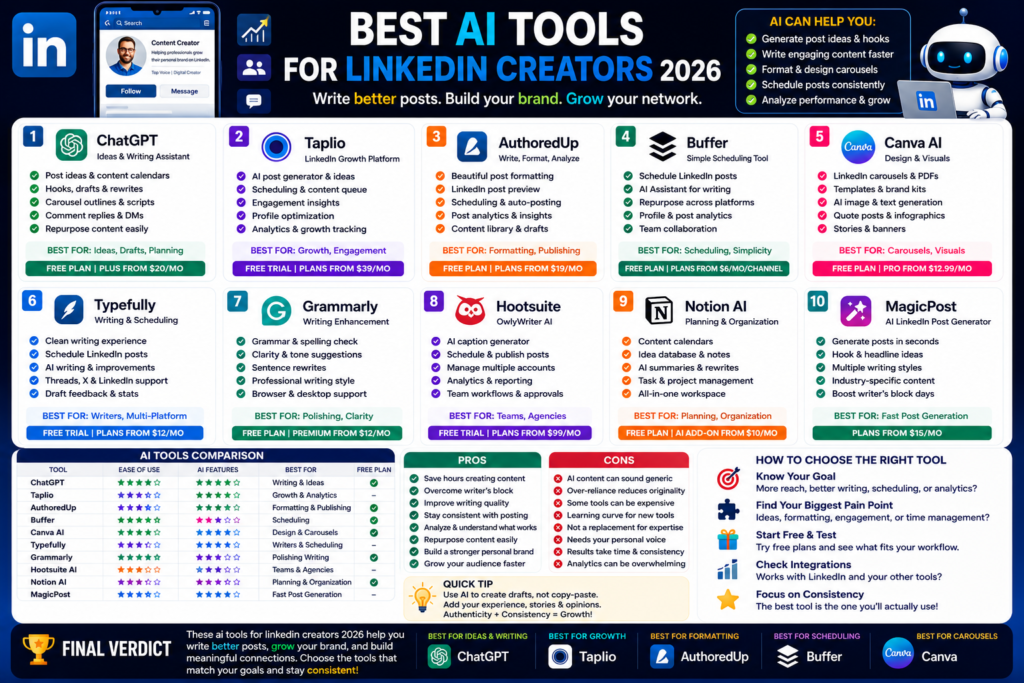
Best AI Tools for LinkedIn Creators 2026
Best AI Tools for LinkedIn Creators 2026: Write Better Posts, Grow Your Brand, and Save Time...
Quick Answer:
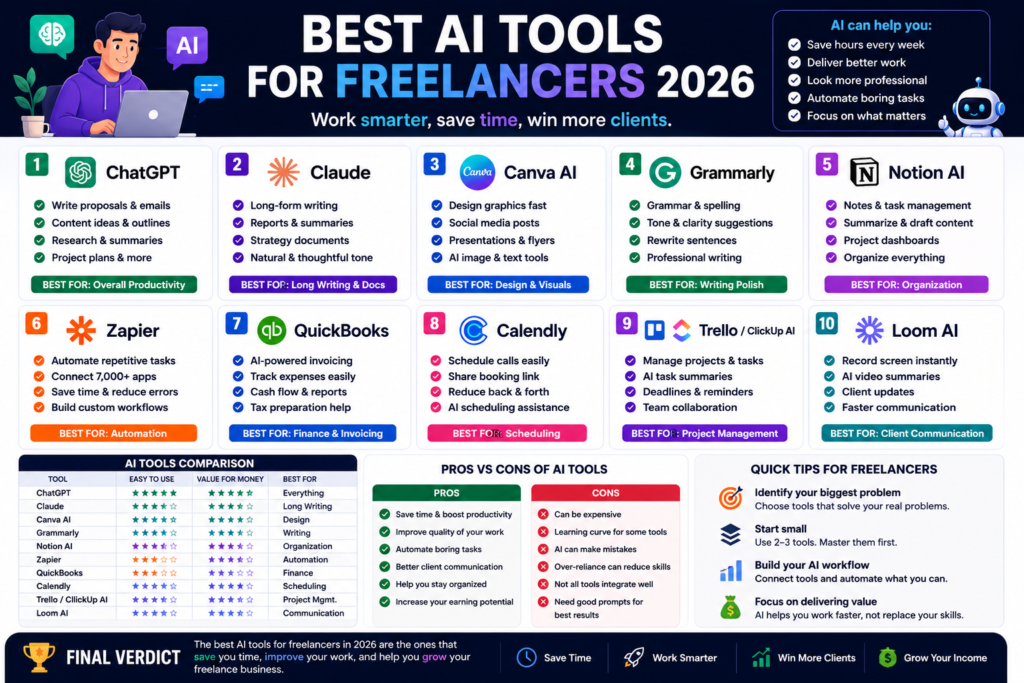
The best ai tools for freelancers 2026 are ChatGPT, Claude, Canva AI, Grammarly, Notion AI, Zapier, QuickBooks, Calendly, Trello/ClickUp AI, and Loom AI. ChatGPT is best overall, Canva is best for design, Grammarly is best for writing polish, Zapier is best for automation, and QuickBooks is best for invoices and finance.
The best ai tools for freelancers 2026 can make freelance work much easier.
And honestly, freelancing is not just doing the client work.
You also have to find leads, write proposals, reply to messages, create invoices, manage deadlines, design content, plan projects, send follow-ups, track payments, and market yourself.
That is a lot for one person.
Here is the thing. AI will not replace your skill. If you are a designer, developer, writer, SEO expert, editor, marketer, or consultant, your real value still comes from your experience.
But AI can help you move faster.
It can help you write better proposals, create client reports, plan projects, summarize calls, draft emails, generate content ideas, design social posts, and automate boring tasks.
In my experience, freelancers who use AI properly look more professional and save more time.
The key is not using every AI tool.
The key is choosing the right tools for the work you actually do.
Not every AI tool is worth paying for.
Some tools look exciting but do not solve a real freelance problem. Some are too expensive. Some create more work than they save.
A good freelance AI tool should do three things.
Freelancers sell time, skill, or outcomes.
So if a tool saves time, it matters.
Good AI tools can help with:
The best tool is not always the most advanced one.
It is the one you actually use every week.
AI should not only make work faster.
It should also make it better.
For example, Grammarly can make your emails cleaner. Canva can make your designs look more professional. ChatGPT can help you structure better proposals. Claude can help polish long client documents.
That is useful.
Small improvements can make you look more reliable.
And clients notice that.
Freelancers have to protect profit.
A $20/month tool can be worth it if it saves hours.
A $100/month tool may also be worth it if it helps you win better clients.
But don’t buy tools just because they are popular.
Start free when possible. Upgrade only when the tool helps you earn more, save time, or deliver better work.
Here are the top freelance AI tools I would actually consider.
ChatGPT is the best all-round AI tool for freelancers.
You can use it for almost everything.
It helps with proposals, client messages, content ideas, email replies, project plans, blog outlines, code explanations, research, meeting summaries, and business strategy.
Best for:
Honestly, ChatGPT is the first tool I would recommend to most freelancers.
For example, you can ask:
“Write a short Upwork proposal for a WordPress speed optimization project. Make it confident, friendly, and not too salesy.”
Or:
“Create a project timeline for a 5-page business website.”
That alone can save time.
Claude is excellent for freelancers who work with long documents.
It is especially useful for writers, consultants, researchers, developers, legal freelancers, and business strategists.
Claude is great for:
In my experience, Claude often sounds more natural than many AI tools.
If ChatGPT feels too direct or too polished, Claude can feel smoother and more thoughtful.
Use Claude when tone matters.
For example, if you are writing a client strategy document or long email, Claude can help make it clear without sounding robotic.
Canva AI is one of the best tools for freelancers who need quick visuals.
You do not need to be a professional designer to create decent graphics with Canva.
Freelancers can use Canva for:
The good news is that Canva has templates, AI design tools, text tools, image tools, and easy editing in one place.
If you are a freelance marketer, VA, content creator, social media manager, or consultant, Canva is very useful.
Honestly, Canva can make a beginner look more professional.
That matters when you are pitching clients.
Grammarly is not flashy, but it is very useful.
Freelancers send messages all day.
You write proposals, emails, updates, contracts, reports, captions, and client replies. One grammar mistake may not destroy your business, but clean writing builds trust.
Grammarly helps with:
If English is not your first language, Grammarly can be especially helpful.
It makes your writing sound cleaner and more confident.
I think every freelancer who writes to clients should use some kind of writing checker.
Notion is great for freelance organization.
You can use it as your second brain.
Notion helps you manage:
Notion AI can help summarize notes, create drafts, organize information, and turn messy ideas into useful documents.
For freelancers, this is very helpful.
Because once you have more than three clients, keeping everything in your head becomes risky.
Use Notion to track what needs to be done, what was promised, and what has been delivered.
Zapier is one of the best AI automation tools for freelancers.
It connects apps together and automates repetitive tasks.
For example:
This may sound small.
But admin tasks can eat your day.
Zapier helps reduce manual work.
If you are a freelancer managing clients, leads, emails, payments, and tasks, automation can save serious time.
Start with one simple automation.
Then add more once it works.
Freelancers often hate finance work.
Invoices, expenses, receipts, taxes, cash flow, late payments. It is not fun, but it matters.
QuickBooks can help freelancers manage:
Its AI features can help organize transactions, highlight insights, and reduce manual accounting work.
This is useful because freelancers need to know their numbers.
You should know:
AI can help, but always review financial details yourself or with an accountant.
Calendly is one of the easiest tools for booking calls.
Instead of sending five messages like “What time works for you?”, you send one link.
The client picks a time.
Done.
Calendly helps with:
Calendly also has AI scheduling and meeting features, including AI scheduling assistance and meeting summaries depending on the feature set.
For freelancers, this is very useful.
It saves time and makes you look professional.
If you sell services, you should make booking easy.
Freelancers need project management.
Even if you work alone, you still need a system.
Trello and ClickUp are both useful for managing tasks, deadlines, content calendars, client projects, and workflows.
Use these tools for:
AI features can help summarize tasks, create project plans, write task descriptions, and organize work.
The best part is visibility.
You can quickly see what is pending, what is done, and what needs client approval.
That reduces stress.
Loom is great for freelancers who need to explain things visually.
Instead of writing a long message, record a short screen video.
This is useful for:
Loom AI can help with summaries, titles, chapters, and quick video notes.
This saves time because clients often understand better when they can see what you mean.
For web developers, designers, marketers, and consultants, Loom is very useful.
Honestly, a two-minute Loom video can replace ten confusing messages.
| Tool | Best For | Free Plan | Best Freelance Use |
|---|---|---|---|
| ChatGPT | Overall productivity | Yes | Proposals, emails, content, planning |
| Claude | Long writing | Yes | Reports, summaries, thoughtful documents |
| Canva AI | Design | Yes | Graphics, presentations, portfolio visuals |
| Grammarly | Writing polish | Yes | Emails, proposals, client messages |
| Notion AI | Organization | Yes / AI credits vary | Client notes, dashboards, content plans |
| Zapier | Automation | Yes | App workflows and admin automation |
| QuickBooks AI | Finance | Paid plans | Invoices, expenses, cash flow |
| Calendly | Scheduling | Yes | Booking client calls |
| Trello / ClickUp AI | Projects | Yes / paid AI varies | Tasks, deadlines, workflows |
| Loom AI | Video updates | Yes / paid AI varies | Client walkthroughs and reports |
AI tools can help freelancers work better.
They can:
In my experience, the biggest benefit is confidence.
AI gives you a starting point when you are stuck.
That helps a lot.
AI tools also have problems.
They can:
Here is the thing.
AI should support your freelance skill, not replace it.
Clients pay for your judgment, not just your tools.
Use AI to speed up the process. Then add your own experience.
Writers can use ChatGPT, Claude, Grammarly, Notion AI, and Canva.
These tools help with outlines, drafts, editing, content calendars, and visuals.
But don’t publish raw AI content.
Add your own examples, opinions, research, and voice.
Designers can use Canva, ChatGPT, Notion, Loom, and Zapier.
AI can help with design briefs, moodboard ideas, presentation text, client updates, and project organization.
It should not replace your creative eye.
But it can speed up the boring parts.
Developers can use ChatGPT, Claude, Notion, Loom, Calendly, and Trello or ClickUp.
AI can help explain code, debug issues, write documentation, plan features, and create client handover videos.
For developers, Loom is especially useful because clients often need visual explanations.
Virtual assistants can use ChatGPT, Zapier, Notion, Calendly, Grammarly, and QuickBooks.
These tools help with admin workflows, emails, scheduling, task management, and reporting.
If you are a VA, AI automation skills can make you more valuable.
Marketers can use ChatGPT, Claude, Canva, Grammarly, Zapier, Notion, and Loom.
These tools help with content ideas, audits, reports, keyword plans, proposals, and client communication.
AI can speed up marketing work, but strategy still matters.
The best AI tools for freelancers in 2026 are ChatGPT, Claude, Canva AI, Grammarly, Notion AI, Zapier, QuickBooks, Calendly, Trello or ClickUp AI, and Loom AI.
ChatGPT is the best free AI tool for most freelancers because it helps with proposals, emails, content ideas, planning, research, and client communication.
Yes, AI can help freelancers write better proposals, improve portfolios, create social content, research leads, write outreach emails, and respond faster to client messages.
ChatGPT and Claude are both great for freelance proposals. ChatGPT is better for fast drafts, while Claude is better for a softer and more natural tone.
No, AI cannot fully replace good freelancers. It can help with drafts, ideas, automation, and admin work, but clients still need human skill, taste, strategy, communication, and judgment.
The best ai tools for freelancers 2026 depend on your work.
But here is my honest recommendation.
Start with ChatGPT for overall productivity.
Add Grammarly for better writing.
Use Canva AI for design and visuals.
Use Notion AI to organize your business.
Use Calendly to book calls.
Use Zapier to automate boring tasks.
Use QuickBooks to manage invoices and expenses.
Use Loom to explain work to clients clearly.
You do not need every tool on this list.
Pick the tools that solve your biggest problem right now.
If you struggle with proposals, use ChatGPT or Claude.
If you struggle with design, use Canva.
If you struggle with admin, use Zapier.
If you struggle with organization, use Notion.
My advice is simple. Build your freelance AI stack slowly. Start with two or three tools. Use them for real client work. Keep what saves time. Drop what creates more work.
AI will not make you a successful freelancer by itself.
But used properly, it can help you work faster, communicate better, win more clients, and protect your time.
For more practical guides like this ai tools for freelancers 2026 article, keep reading AI Daily Tool for honest AI reviews, simple comparisons, and real-world tool recommendations.
Best AI Tools for LinkedIn Creators 2026: Write Better Posts, Grow Your Brand, and Save Time...
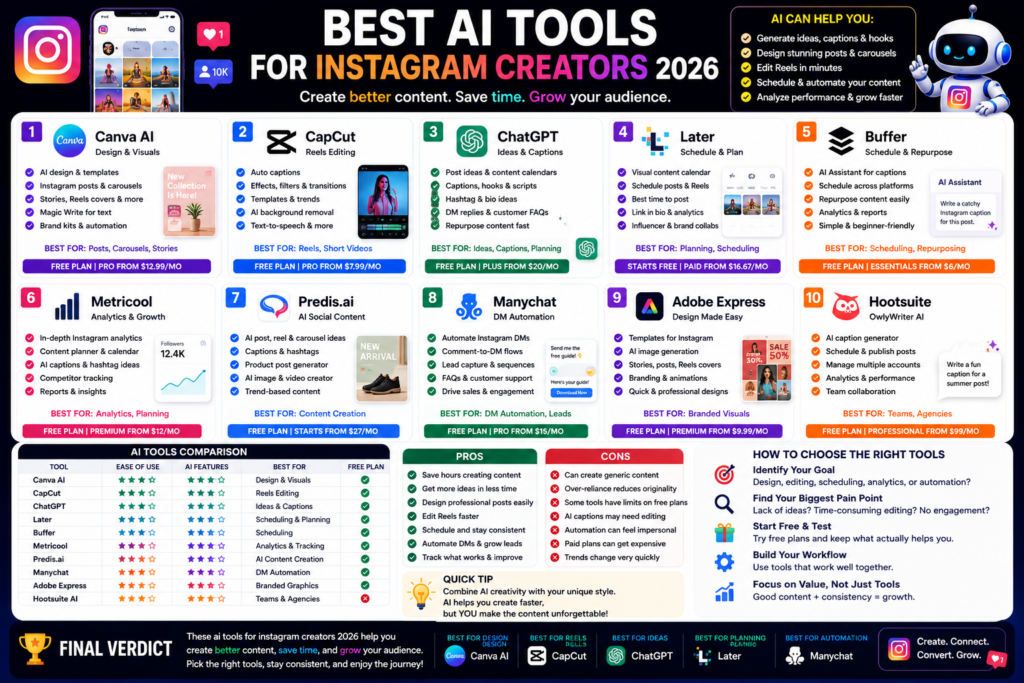
Best AI Tools for Instagram Creators 2026: Create Better Posts, Reels, and Carousels Faster Quick Answer:...
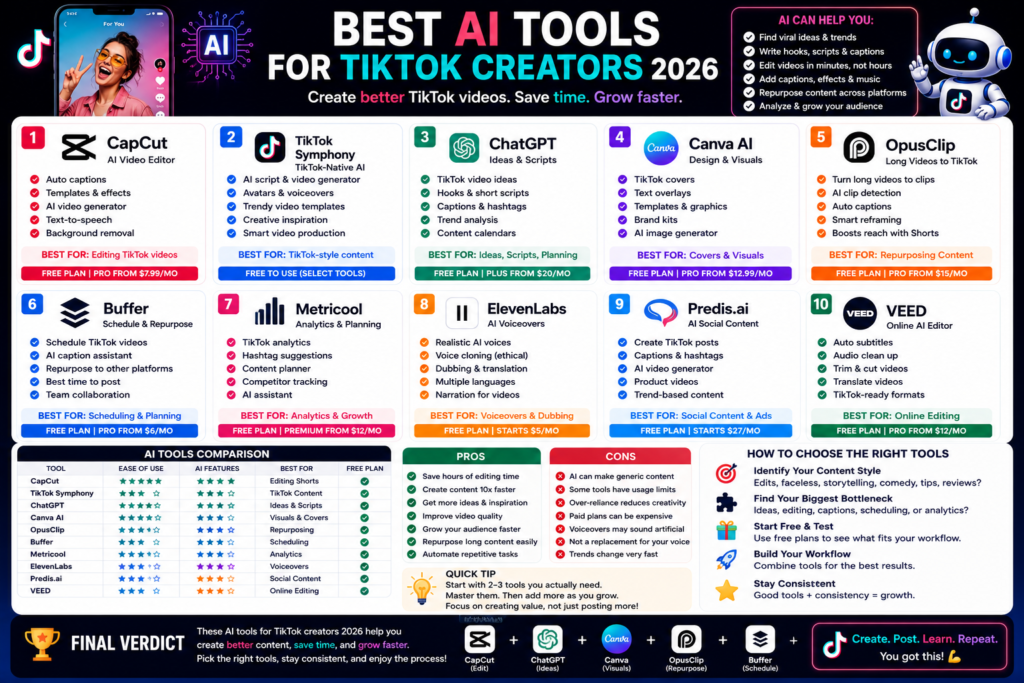
Best AI Tools for TikTok Creators 2026: Create Faster, Edit Smarter, and Grow Your Audience Quick...
Leave a Comment