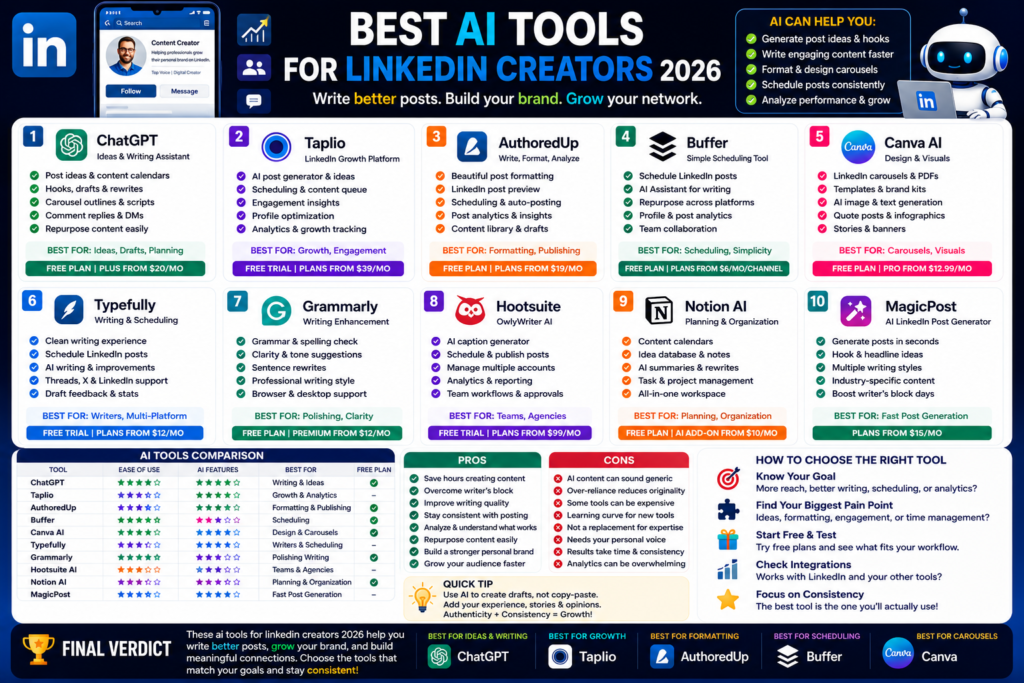
Best AI Tools for LinkedIn Creators 2026
Best AI Tools for LinkedIn Creators 2026: Write Better Posts, Grow Your Brand, and Save Time...
Quick Answer:
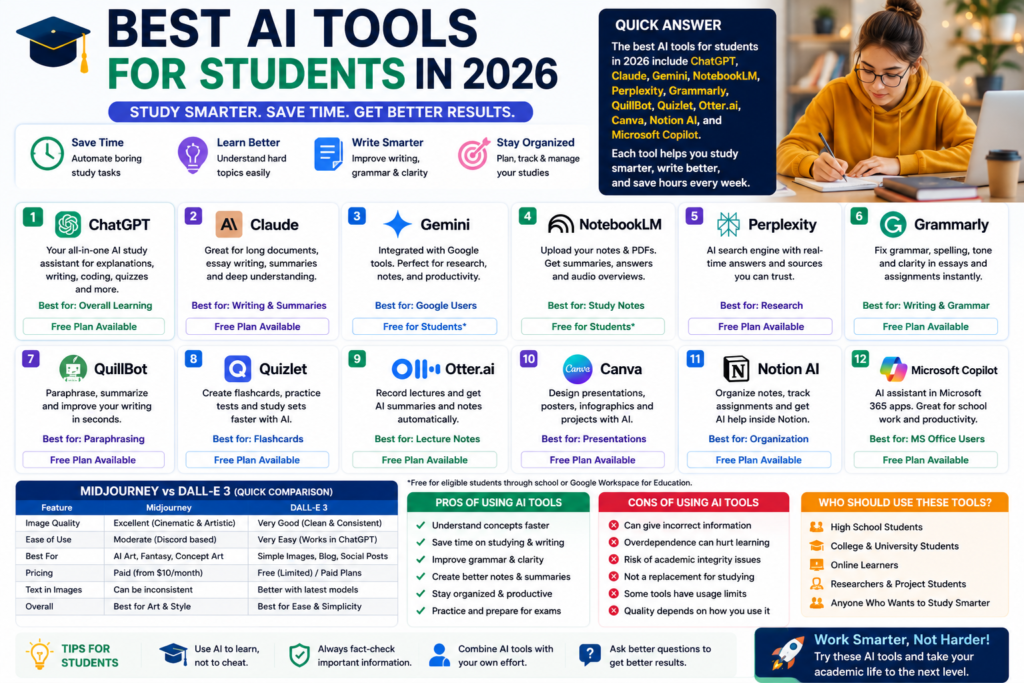
The best ai tools for students 2026 are ChatGPT, Claude, Gemini, NotebookLM, Perplexity, Grammarly, QuillBot, Quizlet, Otter.ai, Canva, Notion AI, and Microsoft Copilot. ChatGPT is best overall, NotebookLM is great for study notes, Grammarly is best for writing polish, and Perplexity is best for research with sources.
The best ai tools for students 2026 are not just for writing essays.
That is the first thing to understand.
AI can help students study faster, understand hard topics, summarize notes, create flashcards, fix grammar, research papers, prepare for exams, and organize assignments. Honestly, I think students who use AI properly have a real advantage.
But here is the thing.
AI should help you learn. It should not replace learning.
If you use AI to cheat, copy answers, or submit work you do not understand, it will hurt you later. But if you use AI like a tutor, editor, research assistant, and study planner, it can be very useful.
In 2026, many tools now have free plans or student-friendly options. ChatGPT Free includes tools like web search, data analysis, image/file uploads, and GPTs, while Gemini and NotebookLM are available for education users in Google Workspace for Education at no charge.
So yes, AI is worth using.
You just need the right tools for the right tasks.
Not every AI tool is good for students.
Some tools are too expensive. Some give vague answers. Some are better for business than studying. And some can make students lazy if used the wrong way.
A good student AI tool should be simple.
You should not need technical skills to use it. You should be able to type a question, upload notes, ask for a summary, or create a quiz without spending hours learning the platform.
For example, ChatGPT, Gemini, Copilot, and Claude are easy because they work like normal chat apps.
That matters when you are tired before an exam.
The best AI study tools do more than give answers.
They help you understand.
A useful tool should help you:
In my experience, the best prompt for students is not “give me the answer.”
It is: “Teach me this step by step, then quiz me.”
Students do not always have a big budget.
That is why free plans matter.
ChatGPT, Gemini, Perplexity, Grammarly, QuillBot, Canva, Quizlet, Copilot, and Notion all offer some kind of free access or free starting point. Some paid tools are worth it, but you do not need to pay for everything.
My advice is simple. Start free. Upgrade only when one tool becomes part of your daily routine.
Here are the best AI tools students should try this year.
ChatGPT is the best overall AI tool for students.
It can explain topics, summarize notes, help with writing, create quizzes, solve practice problems, review essays, and build study plans.
OpenAI says ChatGPT Free users can access a range of capabilities with GPT-5.5, including web search, data analysis, image/file uploads, and GPTs.
You can use ChatGPT for:
Honestly, ChatGPT is best when you ask it to teach, not just answer.
Try this prompt:
“Explain this topic like I’m a beginner. Then ask me five quiz questions and correct my answers.”
That is much better than copying a response.
Claude is excellent for students who read and write a lot.
It is especially good for summarizing long documents, improving essays, explaining complex topics, and rewriting text in a natural tone.
Claude has a free plan, while Claude Pro is listed at $20/month or $17/month with annual billing. Pro includes more usage, Claude Code, projects, Research, and access to more Claude models.
Claude is great for:
In my experience, Claude often sounds more natural than many AI writing tools.
Use it to improve your writing, not replace your writing.
Gemini is a smart choice if your school work already happens inside Google.
If you use Gmail, Google Docs, Drive, Slides, Sheets, or Android, Gemini can fit naturally into your workflow.
Google’s Gemini for Students page says students can still try Gemini for free, while select features may require a Google AI plan, internet, and a compatible account.
Use Gemini for:
Gemini is not always my first choice for writing quality. But for Google users, it is very convenient.
NotebookLM is one of the best AI study tools for students.
You can upload sources, notes, documents, PDFs, and class materials. Then NotebookLM helps you understand them.
Google says the Gemini app and NotebookLM are included in all Google Workspace for Education editions free of charge.
NotebookLM is useful for:
The best part is that NotebookLM works from your materials.
That makes it safer than asking a general chatbot random questions.
Perplexity is great for research.
It works more like an AI search engine than a normal chatbot. Perplexity describes itself as a free AI-powered answer engine that gives accurate, trusted, real-time answers.
Students can use Perplexity for:
Here is the thing.
Perplexity is not the best tool for writing your essay.
It is better for finding and understanding information.
Use it early in your research process.
Grammarly is still one of the best writing tools for students.
It helps with grammar, spelling, punctuation, tone, clarity, and writing confidence. Grammarly’s student page says it gives real-time writing feedback and helps students disclose AI use more easily.
Use Grammarly for:
Honestly, Grammarly is one of those tools that catches small mistakes you miss.
It will not write a great essay for you. But it can make your essay cleaner.
QuillBot is popular with students because it helps rewrite, paraphrase, summarize, and check grammar.
Its free plan includes paraphrasing up to 125 words, 2 modes, basic grammar fixes, limited humanizing, basic summaries, and limited AI Detector access.
Use QuillBot for:
Be careful though.
Paraphrasing does not remove your responsibility to cite sources. If the idea came from someone else, you still need to credit it.
Quizlet is one of the best tools for memorization.
It helps students create flashcards, practice tests, and study activities. Quizlet says students can sign up for free and use interactive flashcards, practice tests, and study activities.
Quizlet’s AI study tools can help students learn faster with practice tests and study support.
Use Quizlet for:
If your subject needs memorization, Quizlet is worth using.
Otter.ai is useful if you attend lectures, study groups, or online classes.
It records and transcribes audio, then helps turn conversations into searchable notes. Otter describes itself as an AI notetaker that creates transcription, automated summaries, AI Chat, and more.
Otter’s free plan includes 300 monthly transcription minutes, 30 minutes per conversation, and 3 lifetime imported audio or video files.
Use Otter for:
Before recording, always check your school rules and ask permission when needed.
Canva is great for students who need visual work.
It helps create presentations, posters, resumes, infographics, social media graphics, and videos. Canva describes itself as a free-to-use online graphic design tool for social posts, presentations, posters, videos, logos, and more.
Canva also includes AI tools in its design app, including text-to-image features and creative design tools.
Use Canva for:
If you are not a designer, Canva makes your work look more polished.
Notion is great for organizing student life.
You can use it for notes, assignments, calendars, class pages, reading lists, research plans, and project tracking.
Notion’s pricing page shows a free plan for individuals, while Notion AI and agents use credits or trials depending on the plan.
Use Notion for:
Notion AI is helpful, but even basic Notion can be powerful for students.
Microsoft Copilot is useful if your school uses Word, PowerPoint, OneNote, Teams, or Edge.
Microsoft says Copilot has features for students, including concept breakdowns, mixed-topic quizzes, homework feedback, webpage or document recaps, and free access through the app.
Use Copilot for:
If your school already uses Microsoft, Copilot is worth trying.
| Tool | Best For | Free Plan | Best Student Use |
|---|---|---|---|
| ChatGPT | Overall study help | Yes | Explanations, writing, quizzes, coding |
| Claude | Writing and long docs | Yes | Essays, summaries, document analysis |
| Gemini | Google users | Yes | Docs, Drive, research, study planning |
| NotebookLM | Source-based study | Yes for Workspace Education | Notes, PDFs, study guides |
| Perplexity | Research | Yes | Source discovery and current answers |
| Grammarly | Grammar and clarity | Yes | Essay polishing and emails |
| QuillBot | Paraphrasing | Yes | Rewriting and summaries |
| Quizlet | Flashcards | Yes | Memorization and test prep |
| Otter.ai | Transcription | Yes | Lecture notes and summaries |
| Canva | Presentations | Yes | Posters, slides, infographics |
| Notion AI | Organization | Free Notion plan | Notes, assignments, study dashboard |
| Copilot | Microsoft users | Yes | Quizzes, summaries, study help |
AI tools can make studying easier.
They help students:
In my experience, AI is best when it turns messy information into something easier to study.
That saves time.
AI tools also have risks.
They can:
Here is the thing. AI is not a shortcut around learning.
It is a shortcut to better learning when used properly.
Always check your school’s AI policy. Some teachers allow AI for brainstorming and editing. Some do not allow it for assignments. Don’t guess.
High school students can use AI for study help, flashcards, grammar, summaries, and practice questions.
Best tools:
Use AI to understand topics, not to copy homework.
College students need stronger research and writing support.
Best tools:
If you have long readings, lectures, papers, and deadlines, these tools can save serious time.
Online learners often study without a teacher beside them.
AI can help fill that gap.
Best tools:
Ask AI to explain topics, quiz you, and create weekly learning plans.
That makes self-study easier.
ChatGPT is the best overall AI tool for students in 2026 because it can explain topics, summarize notes, create quizzes, help with writing, review code, and build study plans.
ChatGPT, Gemini, Perplexity, Grammarly, QuillBot, Quizlet, Canva, and Microsoft Copilot all offer useful free access. The best one depends on whether you need writing, research, flashcards, or design help.
Yes, students can use AI for brainstorming, outlining, grammar help, and feedback. But they should not submit AI-written work as their own if their school does not allow it. Always follow your school’s academic integrity rules.
Perplexity is great for finding sources and current information. NotebookLM is great for working with your own sources. Claude is useful for summarizing long academic text.
AI is not bad by itself. It depends on how students use it. If you use AI to cheat, it hurts learning. If you use AI to explain, quiz, summarize, and improve your work, it can be very helpful.
The best ai tools for students 2026 can save time, reduce stress, and make studying easier.
But the tool matters.
Use ChatGPT for overall learning help.
Use Claude for writing and long documents.
Use Gemini if you live inside Google tools.
Use NotebookLM for class notes and source-based study.
Use Perplexity for research.
Use Grammarly and QuillBot to polish writing.
Use Quizlet for flashcards.
Use Otter.ai for lecture notes.
Use Canva for presentations.
Use Notion to stay organized.
And use Microsoft Copilot if your school works inside Microsoft.
My honest advice is simple. Don’t install every tool. Pick three: one chatbot, one writing helper, and one study organizer. Use them for one week and see what actually improves your grades, focus, and time.
For more practical guides like this ai tools for students 2026 review, keep reading AI Daily Tool for honest AI tool comparisons, beginner guides, and real-world recommendations.
Best AI Tools for LinkedIn Creators 2026: Write Better Posts, Grow Your Brand, and Save Time...
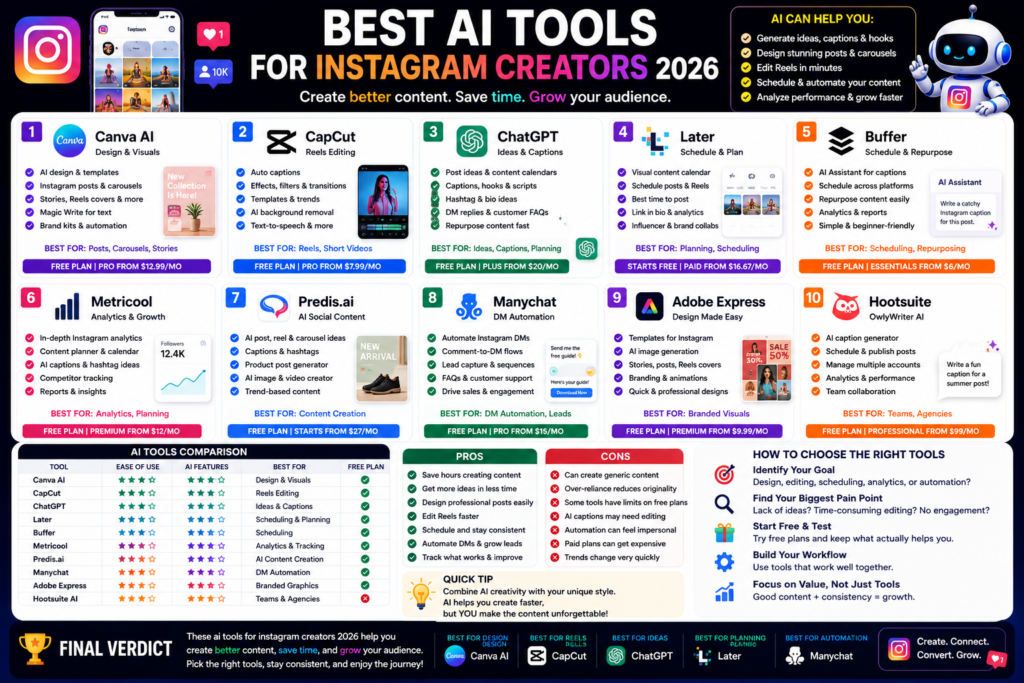
Best AI Tools for Instagram Creators 2026: Create Better Posts, Reels, and Carousels Faster Quick Answer:...
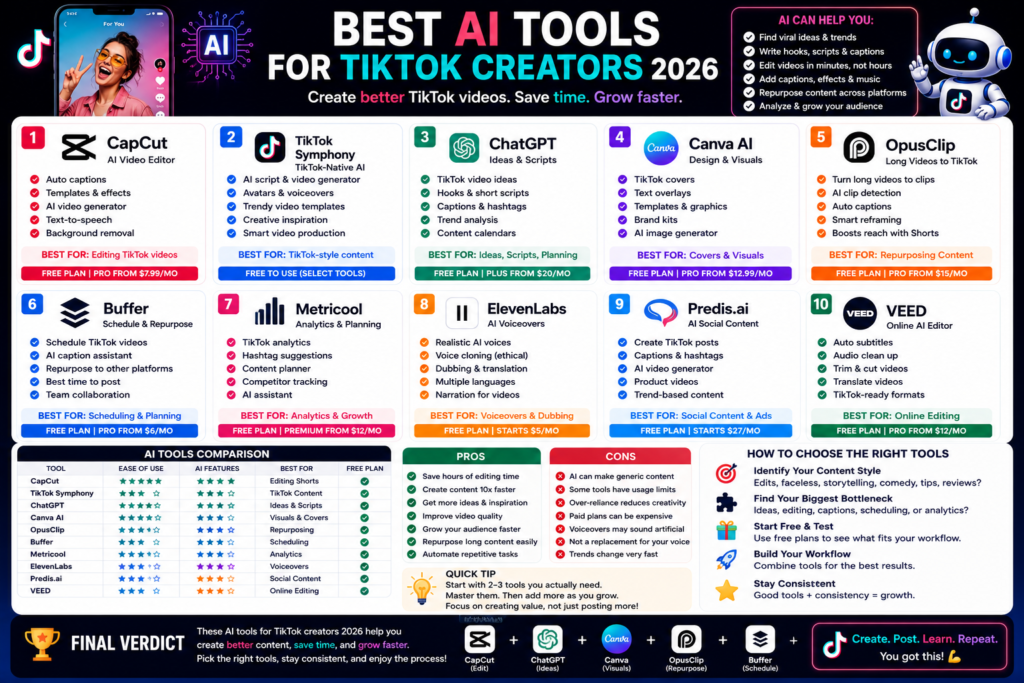
Best AI Tools for TikTok Creators 2026: Create Faster, Edit Smarter, and Grow Your Audience Quick...
Leave a Comment