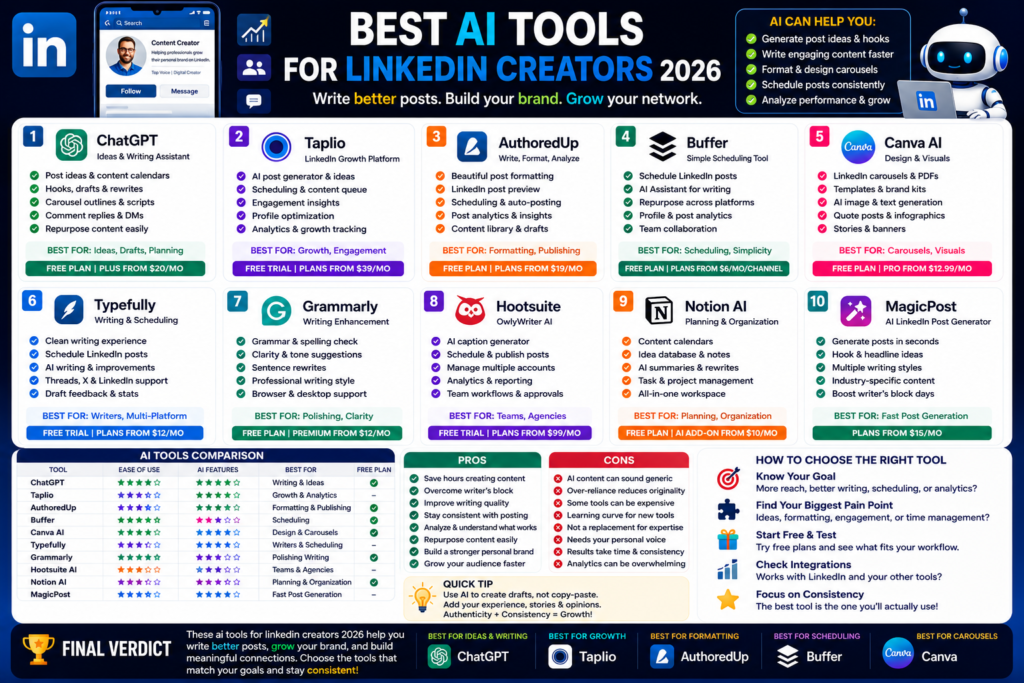
Best AI Tools for LinkedIn Creators 2026
Best AI Tools for LinkedIn Creators 2026: Write Better Posts, Grow Your Brand, and Save Time...
Quick Answer:
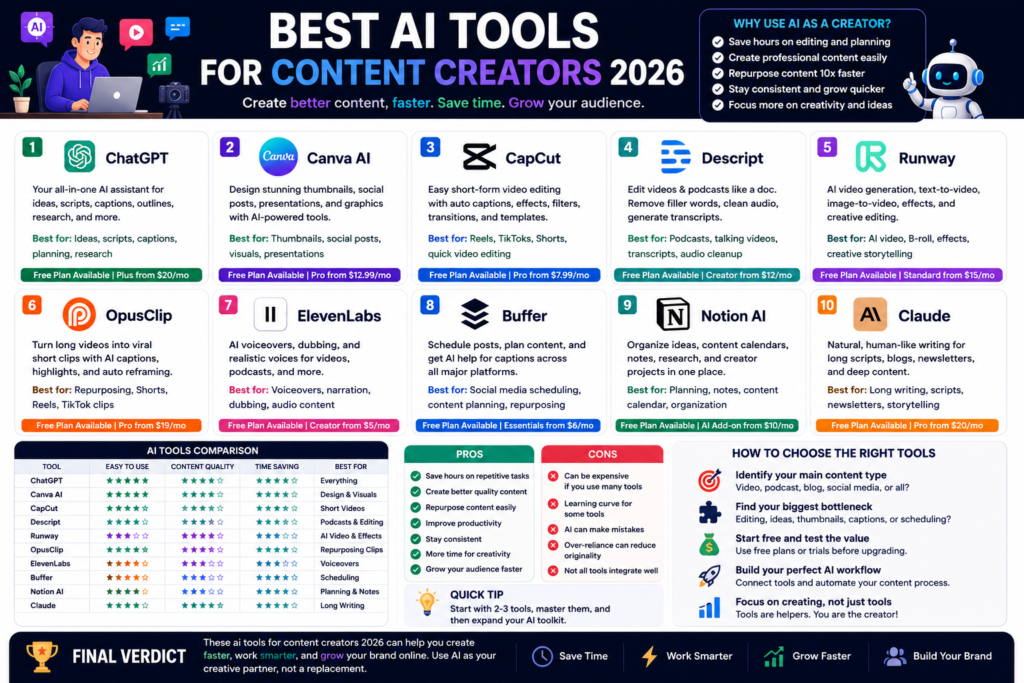
The best ai tools for content creators 2026 are ChatGPT, Canva AI, CapCut, Descript, Runway, OpusClip, ElevenLabs, Buffer, Notion AI, and Claude. ChatGPT is best for ideas and scripts, Canva is best for visuals, CapCut is best for short-form video editing, Descript is best for podcast and video editing, and OpusClip is best for turning long videos into short clips.
The best ai tools for content creators 2026 can save a lot of time.
And honestly, content creation takes more work than most people think.
People see the final YouTube video, Instagram Reel, TikTok, podcast, blog post, or LinkedIn post. But they do not see the planning, scripting, editing, captions, thumbnails, voiceovers, scheduling, repurposing, and analytics behind it.
That is where AI helps.
AI can help you brainstorm ideas, write scripts, create thumbnails, edit videos, generate captions, remove filler words, turn long videos into shorts, create voiceovers, plan content calendars, and schedule posts.
Here is the thing.
AI will not replace your creativity.
Your face, your story, your opinion, your experience, and your taste still matter. AI can help with speed, but it cannot fully replace personality.
The best creators in 2026 will not be the people who let AI do everything.
They will be the people who use AI to remove boring work and spend more time on ideas, storytelling, and audience connection.
Not every AI tool is useful for creators.
Some tools look impressive but do not fit a real workflow. Some are too expensive. Some create generic content. Some make videos that look good for five seconds but are not actually useful.
A good creator AI tool should help with three things.
Editing is one of the biggest time drains.
A 10-minute video can take hours to edit.
AI tools can help with:
If a tool saves you two hours every week, it may be worth paying for.
AI should not only help you create faster.
It should help you create better.
For example, Canva can improve your thumbnails and social graphics. ChatGPT can improve your hooks. Descript can clean your audio. ElevenLabs can create professional voiceovers. Buffer can help your posts fit each platform.
Better quality usually means better watch time, more clicks, more shares, and stronger trust.
A YouTuber needs different tools than a TikTok creator.
A podcaster needs different tools than a blogger.
A LinkedIn creator needs different tools than an Instagram creator.
So choose tools based on where you publish.
Do not buy a video generation tool if your main content is newsletters.
Do not pay for podcast editing software if you only create carousels.
Pick tools that match your real work.
Here are the best AI tools I would actually consider as a content creator.
ChatGPT is the best overall AI assistant for creators.
You can use it for almost every part of content planning.
Best for:
Honestly, ChatGPT is one of the easiest tools to recommend because it is flexible.
For example, you can ask:
“Give me 20 YouTube video ideas for a beginner fitness channel.”
Or:
“Write 10 hooks for a TikTok about saving money as a student.”
Or:
“Turn this blog post into 5 LinkedIn posts and 3 Instagram carousel ideas.”
That is useful.
The best way to use ChatGPT is not to ask for finished content only. Use it as a brainstorming partner.
Let it create options. Then choose the best one and add your own voice.
Canva AI is one of the best tools for creators who need visuals.
If you create content online, you need design.
You may need:
Canva makes this much easier.
You can use templates, AI design tools, text tools, background remover, image editing, Magic Write, and other creative features.
In my experience, Canva is perfect for creators who are not professional designers but still want clean-looking content.
A good thumbnail or carousel can make a big difference.
People often decide whether to click before they even read your caption.
So visuals matter.
CapCut is one of the best tools for TikTok, Instagram Reels, YouTube Shorts, and short-form videos.
It is easy to use and has many creator-friendly features.
Best for:
CapCut is popular because it feels made for creators, not professional film editors only.
You can edit quickly, add captions, use effects, resize videos, and prepare content for social media.
If you create short videos regularly, CapCut should be on your list.
Honestly, for beginners, CapCut is easier than traditional video editing software.
It helps you move fast.
And speed matters when you need to post consistently.
Descript is excellent for creators who record podcasts, interviews, tutorials, courses, or talking-head videos.
The main reason people like Descript is simple.
It lets you edit audio and video like editing text.
That means you can remove words from a transcript and edit the video at the same time.
Best for:
This is very helpful if you create long-form content.
For example, a podcaster can record an episode, generate a transcript, remove mistakes, clean the audio, and create clips from the same recording.
That saves time.
I think Descript is one of the best tools for creators who talk on camera or record audio often.
Runway is one of the most powerful AI video tools.
It is not just for basic editing. It is more for creators who want AI-generated video, cinematic clips, visual effects, and creative experiments.
Best for:
Runway can be useful for YouTubers, filmmakers, editors, music video creators, advertisers, and creative brands.
But here is my honest opinion.
Runway is powerful, but it is not always the first tool beginners need.
If you only need simple Reels, use CapCut first.
If you want advanced AI visuals, cinematic B-roll, or creative video concepts, Runway is more interesting.
OpusClip is perfect for repurposing content.
If you create long videos, interviews, podcasts, webinars, or livestreams, OpusClip can help turn them into short clips.
Best for:
This is a big deal because repurposing is one of the smartest creator strategies.
One long video can become:
OpusClip helps with the short video part.
In my experience, creators who repurpose content well grow faster because they get more value from every recording.
ElevenLabs is one of the best AI voice tools.
It is useful if you need voiceovers, narration, dubbing, character voices, or audio content.
Best for:
If you do not want to record your own voice every time, AI voice tools can help.
But use them carefully.
A voiceover should still sound natural and match your brand.
For creators, ElevenLabs can be useful for faceless YouTube channels, explainer videos, product demos, educational content, and multilingual content.
Just make sure you follow platform rules and use voices ethically.
Buffer is great for creators who post across multiple platforms.
It helps with social media scheduling, post planning, content organization, and AI-assisted writing.
Best for:
Creators often waste time posting manually.
Buffer helps you plan ahead.
For example, you can write one idea and turn it into different versions for LinkedIn, Instagram, X, and Facebook.
That is helpful because each platform has a different style.
A LinkedIn post should not always sound like an Instagram caption.
Buffer helps with that.
Notion AI is great for organizing your creator business.
Content creators need a system.
Without a system, ideas get lost, deadlines are missed, and content becomes random.
Notion can help you manage:
Notion AI can summarize notes, draft content, organize ideas, and clean up messy planning.
This is especially useful if you create content consistently.
In my opinion, Notion is not just a note-taking tool.
It can become your creator command center.
Claude is excellent for creators who care about writing quality.
It is especially good for long-form scripts, newsletters, thoughtful captions, educational content, and natural-sounding writing.
Best for:
Claude often sounds natural and smooth.
If ChatGPT gives you something that feels too structured or direct, Claude can help soften the tone.
For creators who write a lot, Claude is worth testing.
It is especially useful for YouTube scripts, LinkedIn posts, essays, newsletters, and educational content.
| Tool | Best For | Free Plan | Best Creator Use |
|---|---|---|---|
| ChatGPT | Ideas and scripts | Yes | Hooks, scripts, captions, planning |
| Canva AI | Visual content | Yes | Thumbnails, posts, carousels |
| CapCut | Short videos | Yes | Reels, TikToks, Shorts |
| Descript | Podcast and video editing | Yes / trial options | Transcripts, editing, audio cleanup |
| Runway | AI video generation | Yes / credits | Creative AI video and visual effects |
| OpusClip | Repurposing videos | Yes / credits | Long video to short clips |
| ElevenLabs | AI voiceovers | Yes / paid plans | Narration and dubbing |
| Buffer | Social scheduling | Yes | Publishing and repurposing |
| Notion AI | Planning | Yes / paid AI varies | Content calendars and organization |
| Claude | Natural writing | Yes | Long scripts and newsletters |
AI tools can help creators move faster.
They can:
In my experience, the biggest benefit is consistency.
AI helps you keep creating when you feel stuck.
That matters because creators grow by showing up again and again.
AI tools also have problems.
They can:
Here is the thing.
AI can help you create content, but it cannot create your real perspective.
Your opinions still matter.
Your experience still matters.
Your taste still matters.
So use AI as an assistant, not as your identity.
YouTubers can use ChatGPT for scripts, Canva for thumbnails, Descript for editing, OpusClip for Shorts, and Runway for creative visuals.
This is a strong creator stack.
You can plan, record, edit, repurpose, and publish faster.
Short-form creators should use CapCut, Canva, ChatGPT, OpusClip, and Buffer.
These tools help with hooks, captions, editing, templates, and scheduling.
If you post often, this can save hours.
Podcasters should test Descript, ElevenLabs, OpusClip, ChatGPT, and Notion.
Descript helps with editing and transcripts.
OpusClip helps turn episodes into short clips.
ChatGPT helps create titles, show notes, and social posts.
Writers should use ChatGPT, Claude, Grammarly, Canva, and Notion.
AI can help with outlines, research, editing, visuals, and content calendars.
But always add your own examples and opinions.
Raw AI writing is usually not enough.
Faceless YouTube and TikTok creators can use ElevenLabs, Runway, Canva, ChatGPT, and CapCut.
These tools can help with scripts, voiceovers, visuals, editing, and thumbnails.
But be careful.
Faceless content still needs quality. Low-effort AI videos are everywhere now, and audiences can feel it.
The best AI tools for content creators in 2026 are ChatGPT, Canva AI, CapCut, Descript, Runway, OpusClip, ElevenLabs, Buffer, Notion AI, and Claude.
ChatGPT is one of the best free AI tools for creators because it helps with ideas, scripts, captions, hooks, outlines, and content planning. Canva, CapCut, Buffer, and OpusClip also offer useful free options.
For YouTube creators, ChatGPT is best for scripts, Canva is best for thumbnails, Descript is best for editing, OpusClip is best for Shorts, and ElevenLabs is best for voiceovers.
CapCut is one of the best tools for short-form videos because it is easy to use and built for TikTok, Reels, and Shorts. OpusClip is better if you want to turn long videos into short clips.
No, AI cannot fully replace good content creators. AI can help with scripts, editing, captions, voiceovers, and planning, but creators still need personality, taste, storytelling, trust, and real experience.
The best ai tools for content creators 2026 depend on what you create.
But here is my honest recommendation.
Start with ChatGPT for ideas and scripts.
Use Canva AI for thumbnails and graphics.
Use CapCut for short videos.
Use Descript if you create podcasts or talking-head videos.
Use OpusClip if you want to repurpose long videos into short clips.
Use ElevenLabs if you need voiceovers.
Use Buffer to schedule and repurpose posts.
Use Notion AI to organize your content system.
Use Claude for long scripts and natural writing.
You do not need all ten tools.
Start with two or three.
For most creators, the best beginner stack is ChatGPT, Canva, and CapCut. That covers ideas, visuals, and editing.
Then add tools based on your workflow.
If you make long videos, add OpusClip or Descript.
If you need voiceovers, add ElevenLabs.
If you need planning, add Notion.
AI can help you create faster, but your content still needs your voice.
That is what makes people follow you.
For more practical guides like this ai tools for content creators 2026 article, keep reading AI Daily Tool for simple AI reviews, honest comparisons, and real-world creator tools.
Best AI Tools for LinkedIn Creators 2026: Write Better Posts, Grow Your Brand, and Save Time...
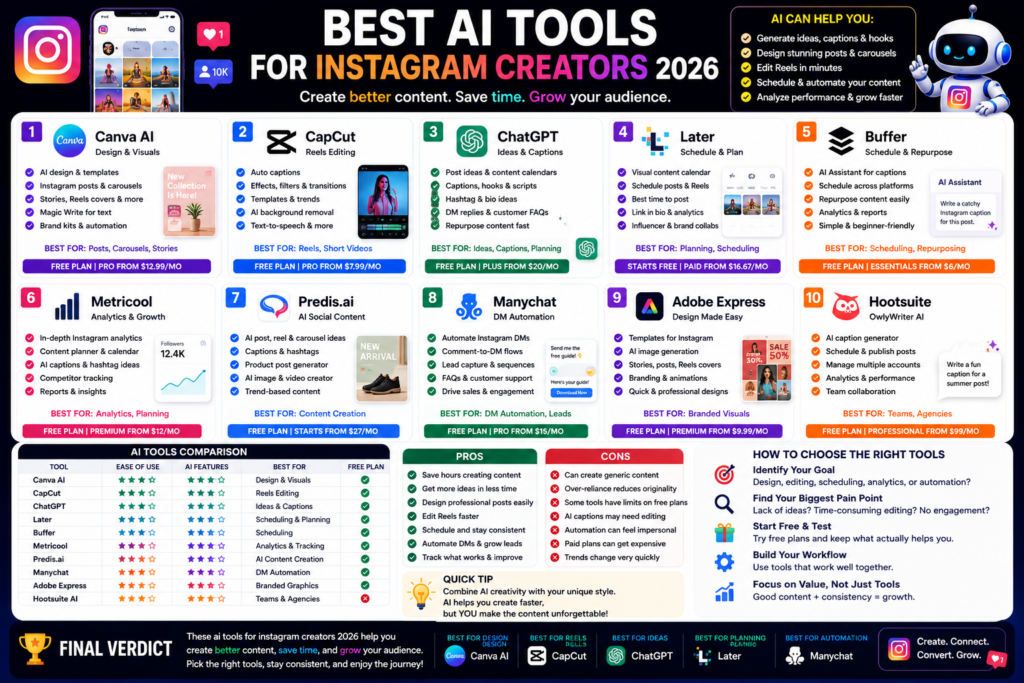
Best AI Tools for Instagram Creators 2026: Create Better Posts, Reels, and Carousels Faster Quick Answer:...
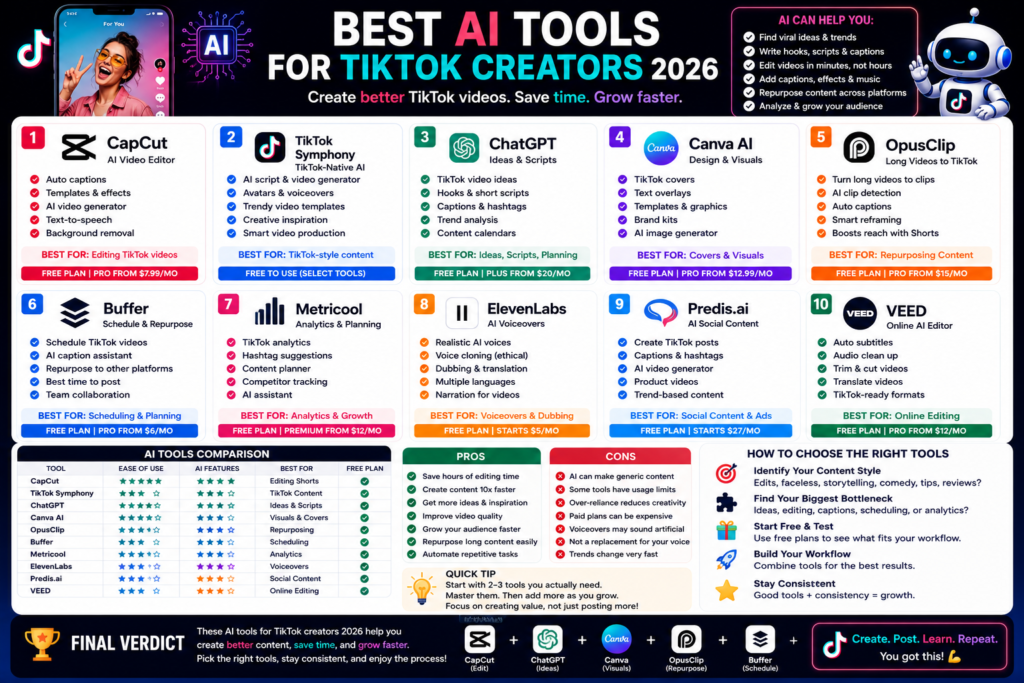
Best AI Tools for TikTok Creators 2026: Create Faster, Edit Smarter, and Grow Your Audience Quick...
Leave a Comment