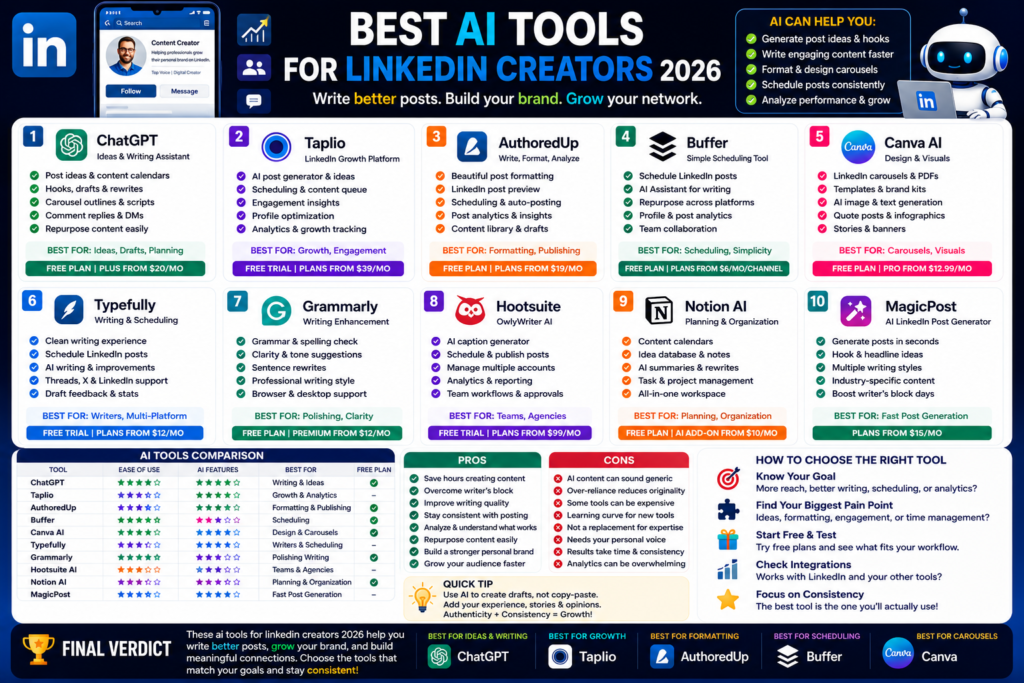
Best AI Tools for LinkedIn Creators 2026
Best AI Tools for LinkedIn Creators 2026: Write Better Posts, Grow Your Brand, and Save Time...
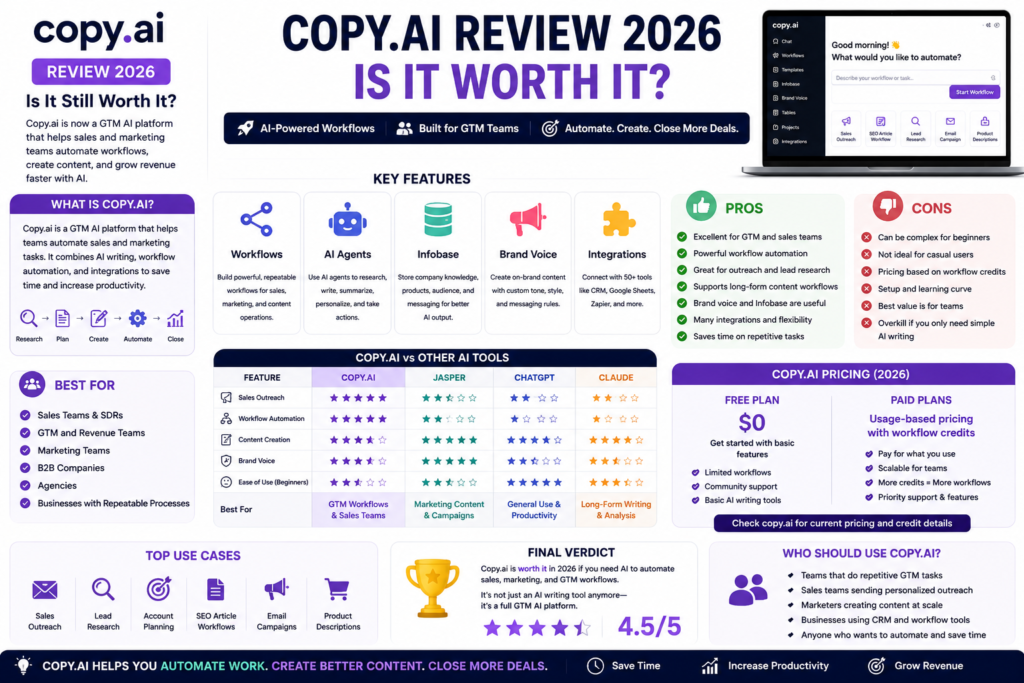
Quick Answer:
Copy.ai is worth using in 2026 if your business needs AI for sales outreach, marketing workflows, content generation, lead research, and go-to-market automation. It is no longer just a simple AI copywriting tool. It is now more useful for teams that want repeatable AI workflows.
This copy ai review 2026 needs to start with one important point.
Copy.ai has changed.
A few years ago, most people knew Copy.ai as an AI copywriting tool. You opened it, picked a template, and created blog intros, product descriptions, ads, emails, or social media captions.
That version of Copy.ai was simple.
In 2026, Copy.ai feels more like a GTM AI platform. GTM means go-to-market. That includes sales, marketing, operations, lead research, outbound campaigns, account planning, content workflows, and automation.
Honestly, this makes Copy.ai more powerful, but also less simple.
If you only want a basic AI writing assistant, ChatGPT or Claude may be easier. But if you want AI to help with repeatable sales and marketing processes, Copy.ai becomes much more interesting.
Here is the thing.
Copy.ai is no longer only about writing one piece of content. It is more about building workflows that help your team do repetitive work faster.
Copy.ai helps businesses create and automate sales and marketing work.
You can use it for:
The good news is that Copy.ai can still write content.
But the bigger value is workflow automation.
For example, instead of asking AI to “write an email,” you can build a workflow that researches a company, finds pain points, creates a personalized email, and prepares follow-up messages.
That is a much bigger use case.
Copy.ai is built by CopyAI, Inc.
The company started as one of the early popular AI writing platforms. Over time, it shifted toward business workflows, sales and marketing automation, and GTM operations.
That shift matters because Copy.ai now competes with tools like Jasper, HubSpot Breeze, Clay, ChatGPT, and other AI workflow platforms.
It is not only competing with simple writing tools anymore.
Copy.ai has several features, but some matter more than others.
Let’s keep it practical.
Workflows are the biggest reason to use Copy.ai in 2026.
A workflow is a repeatable AI process.
For example:
That is much better than doing each step manually.
In my experience, workflows are useful when your team repeats the same task again and again.
For example, sales teams often research leads and write outreach emails every day. Marketing teams often create article outlines, social posts, and email campaigns every week.
Copy.ai helps turn those repeated tasks into systems.
Copy.ai also uses AI agents.
An AI agent is basically an AI-powered helper that can complete a more specific task inside a workflow.
For example, one agent may research a company. Another may create a summary. Another may write an email. Another may check the output.
This is useful because business work usually has multiple steps.
A simple chatbot can answer one prompt. But a workflow with agents can handle a process.
That is where Copy.ai feels more advanced than a normal AI content generator.
Brand Voice is another useful feature.
AI content often sounds generic. It can be too polished, too boring, or too robotic.
Brand Voice helps Copy.ai create content that matches your company tone, audience, and messaging.
This is useful for:
Honestly, brand voice matters more than many people think.
If every AI-generated message sounds the same, your marketing becomes forgettable.
Copy.ai also includes Infobase.
Infobase is where you can store important company information. This may include your product details, audience notes, positioning, offers, messaging, FAQs, and internal knowledge.
The goal is simple.
You want AI to understand your business before it creates content.
Without business context, AI gives average results. With better context, it can create more useful output.
This is especially helpful for teams.
Instead of each person explaining the business again and again, the information can live in one place.
Copy.ai is also designed for GTM systems.
That means it can support workflows across sales, marketing, and operations.
This matters if your team uses tools like CRMs, spreadsheets, sales platforms, email tools, and marketing systems.
The goal is not only to create words.
The goal is to connect work.
That is why Copy.ai makes more sense for teams than casual users.
Copy.ai pricing is one of the trickier parts of this review.
Why?
Because Copy.ai is no longer just a simple monthly AI writing tool.
Its current pricing model is more focused on workflows, credits, implementation, and business use cases.
Copy.ai does offer ways to try the platform.
This is useful if you want to test basic writing tools, workflows, or templates before making a serious decision.
But here is my honest opinion.
You should not judge Copy.ai only by writing one caption or one blog intro.
The real value comes from workflows.
So if you test Copy.ai, test it with a real business task.
For example:
That is how you know whether it is useful.
Copy.ai uses workflow credits.
A credit represents the compute needed to run workflow tasks. Different workflows can use different amounts of credits depending on complexity.
For example, a simple writing task may use fewer credits.
A longer workflow with research, content generation, multiple steps, and integrations may use more.
This makes sense for a workflow platform, but it also means pricing can feel less simple than old AI writing tools.
Copy.ai can be affordable or expensive depending on how you use it.
If you only need a few pieces of copy each month, it may feel expensive compared with ChatGPT.
But if your team uses it to automate lead research, sales outreach, content workflows, and marketing operations, the value can be much higher.
Here is the thing.
The right question is not only “How much does Copy.ai cost?”
The better question is:
“How much manual work can Copy.ai remove from my sales or marketing process?”
If it saves your team hours every week, it can be worth it.
If it only writes a few captions, it may not be.
| Tool | Best For | Free / Trial | Main Strength | Main Weakness |
|---|---|---|---|---|
| Copy.ai | GTM workflows and sales automation | Yes / trial options | Workflow automation | Can feel complex |
| Jasper | Marketing content and brand voice | Trial | Campaign content | More expensive for solo users |
| ChatGPT | General writing and productivity | Yes | Flexible and easy | Less workflow-focused |
| Claude | Natural writing and long documents | Yes | Human-like writing | Less GTM-focused |
| HubSpot Breeze | CRM and customer workflows | Varies | Built into HubSpot | Best only for HubSpot users |
| Canva AI | Visual marketing content | Yes | Design and graphics | Not mainly for sales workflows |
Copy.ai is not the best tool for everyone.
But for GTM workflows, it is one of the more interesting options.
Copy.ai has some clear strengths.
In my experience, the biggest benefit is repeatability.
If you do the same task every week, Copy.ai can help turn it into a system.
Copy.ai also has some downsides.
Here is the thing.
Copy.ai is powerful if you know what process you want to improve.
If you do not know your process, the tool may feel overwhelming.
A lot of people compare Copy.ai with ChatGPT.
And honestly, that makes sense.
Both can write content. Both can help with ideas. Both can create emails, captions, and outlines.
But they are not the same.
ChatGPT is better if you want one flexible AI assistant.
Use ChatGPT for:
ChatGPT is easier for beginners.
It is also usually better if you just want quick writing help.
Copy.ai is better if your team needs repeatable GTM processes.
Use Copy.ai for:
So here is the simple difference.
ChatGPT is better for one-off tasks.
Copy.ai is better for repeatable business processes.
Choose ChatGPT if you are a freelancer, student, solo blogger, or small business owner who needs general AI help.
Choose Copy.ai if you are a sales team, marketing team, agency, or B2B company that needs workflow automation.
That is the honest answer.
Copy.ai and Jasper are closer competitors.
Both are built for business users. Both help with marketing. Both support brand voice. Both are more advanced than basic AI writing tools.
But they focus on different things.
Jasper is better if your main goal is on-brand marketing content.
Use Jasper for:
Jasper feels more content-first.
Copy.ai is better if your main goal is sales and workflow automation.
Use Copy.ai for:
Copy.ai feels more workflow-first.
If you are a content team, choose Jasper.
If you are a sales or GTM team, choose Copy.ai.
If you are a solo user, test ChatGPT first before paying for either.
Copy.ai is not for everyone.
But it is very useful for certain users.
Sales teams can use Copy.ai for prospecting, account research, personalized outreach, and follow-up emails.
This is probably one of its strongest use cases.
A sales rep should not spend hours manually researching every lead. AI can speed that up.
But the final message still needs human review.
Marketing teams can use Copy.ai for blog workflows, campaign ideas, SEO briefs, product copy, and social media content.
The workflow system helps when content production has repeated steps.
For example, a team can create a repeatable SEO article workflow that goes from topic to outline to draft.
Agencies can use Copy.ai to build repeatable client workflows.
This can help with:
If an agency handles similar tasks for many clients, workflows can save time.
B2B companies may get the most value from Copy.ai.
Why?
Because B2B sales and marketing often involve research, personalization, account planning, and repeatable outreach.
That is exactly where Copy.ai fits.
Copy.ai is not always the right choice.
You may not need it if:
In those cases, ChatGPT, Claude, Grammarly, or Canva AI may be enough.
The truth is, Copy.ai is best when there is a process to automate.
Without a process, it may feel like too much.
Here are the best ways to use Copy.ai in 2026.
Copy.ai can help create personalized outbound emails.
You can build workflows that research prospects, identify pain points, and draft messages.
This is much better than sending the same generic email to everyone.
Copy.ai can help with SEO articles.
You can create workflows for:
You still need editing and SEO review, but it can speed up the process.
Ecommerce teams can use Copy.ai to create product copy at scale.
This is useful if you have many products and need unique descriptions.
B2B teams can use Copy.ai to create account summaries, research target companies, and prepare sales talking points.
This helps sales reps prepare faster.
Marketing teams can use Copy.ai for email subject lines, body copy, follow-ups, and campaign variations.
That makes testing easier.
Yes, Copy.ai is worth it in 2026 if you need AI-powered sales and marketing workflows. It is especially useful for GTM teams, sales outreach, lead research, content workflows, and business process automation.
Copy.ai offers free or trial access depending on the current plan options, but its deeper value comes from workflows, workflow credits, and team-focused GTM automation.
Copy.ai is better for repeatable GTM workflows and sales automation. ChatGPT is better for general writing, brainstorming, research, and everyday productivity.
Yes, Copy.ai can help with blog writing, outlines, SEO articles, intros, and content workflows. But Jasper, ChatGPT, and Claude may feel better for pure long-form writing.
Copy.ai is best for sales teams, GTM teams, marketing teams, agencies, B2B companies, and businesses that want to automate repeatable sales and marketing tasks.
So, what is my honest opinion after this copy ai review 2026?
Copy.ai is worth it, but only for the right user.
If you want a simple AI writing assistant, Copy.ai may feel too advanced. ChatGPT or Claude will probably be easier.
But if your business needs repeatable sales outreach, lead research, SEO workflows, account planning, email campaigns, and GTM automation, Copy.ai can be very useful.
The biggest strength is not basic copywriting anymore.
The real strength is workflows.
That is what makes Copy.ai different in 2026.
My advice is simple. Don’t test Copy.ai with random prompts. Test it with a real business workflow. Use it for lead research, outbound email, SEO article creation, or account planning.
If it saves time there, it may be worth paying for.
If you only need occasional copy, use a simpler tool.
For more practical reviews like this copy ai review 2026, keep reading AI Daily Tool for honest AI tool comparisons, beginner guides, and real-world recommendations.
Best AI Tools for LinkedIn Creators 2026: Write Better Posts, Grow Your Brand, and Save Time...
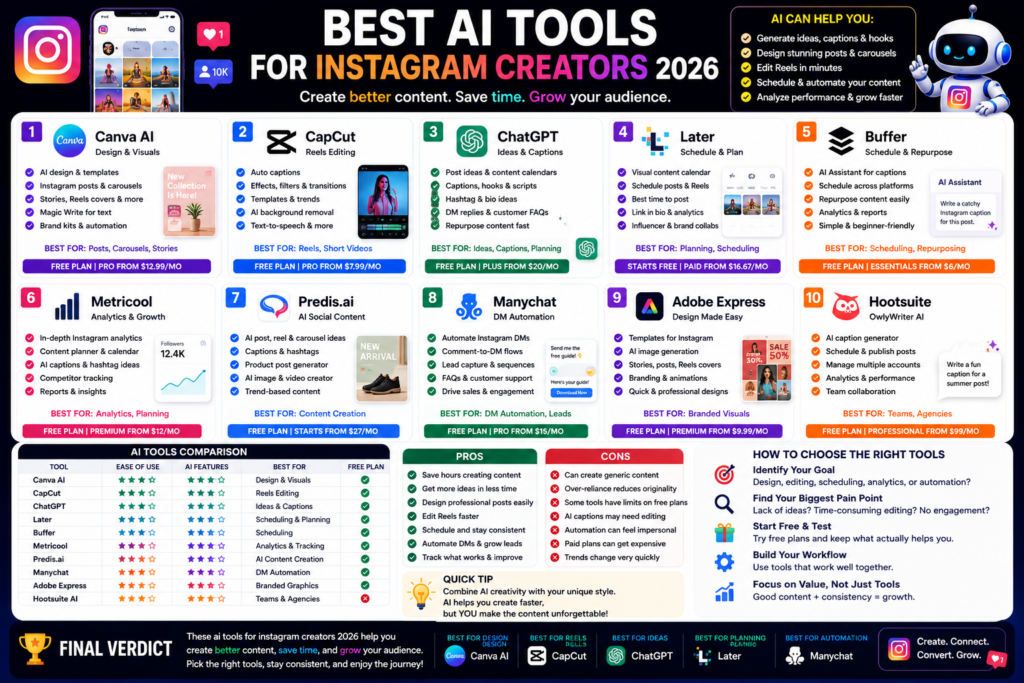
Best AI Tools for Instagram Creators 2026: Create Better Posts, Reels, and Carousels Faster Quick Answer:...
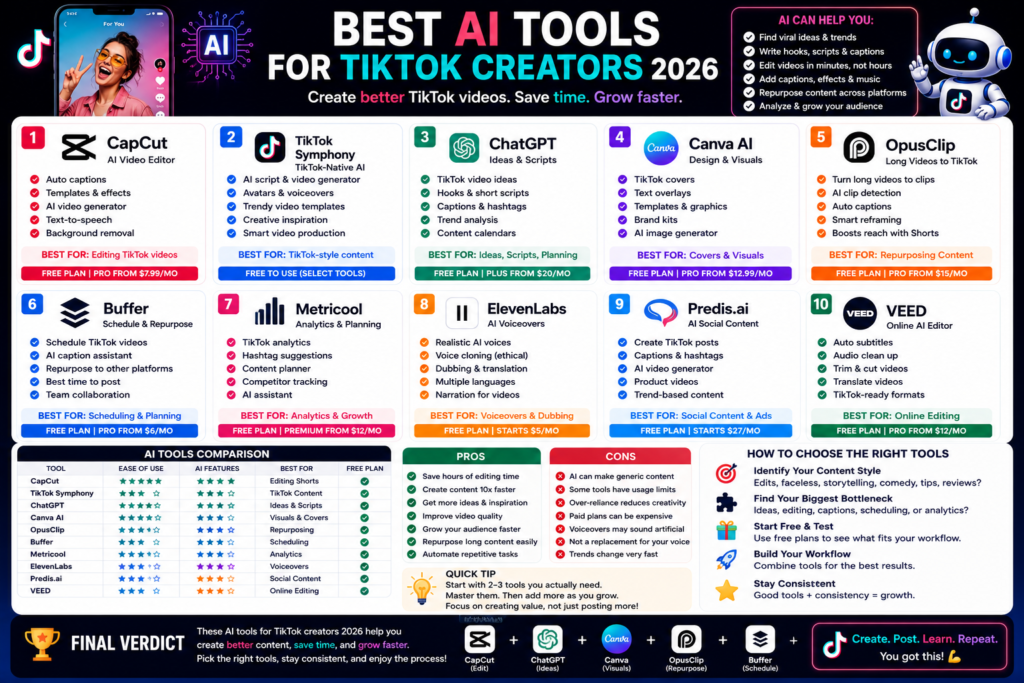
Best AI Tools for TikTok Creators 2026: Create Faster, Edit Smarter, and Grow Your Audience Quick...
Leave a Comment