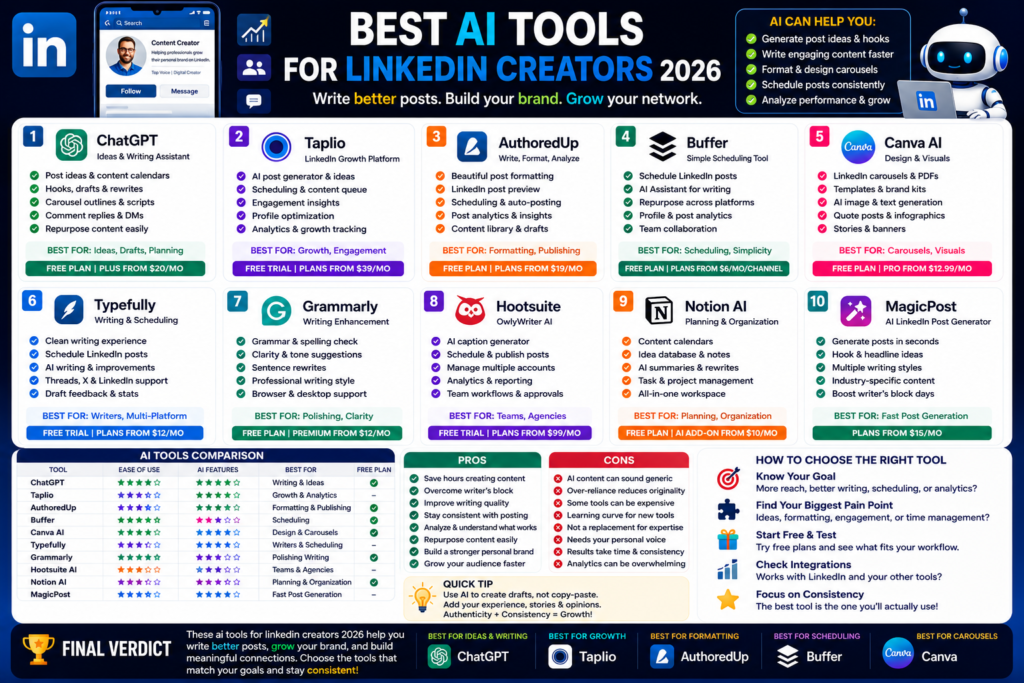
Best AI Tools for LinkedIn Creators 2026
Best AI Tools for LinkedIn Creators 2026: Write Better Posts, Grow Your Brand, and Save Time...
Quick Answer:
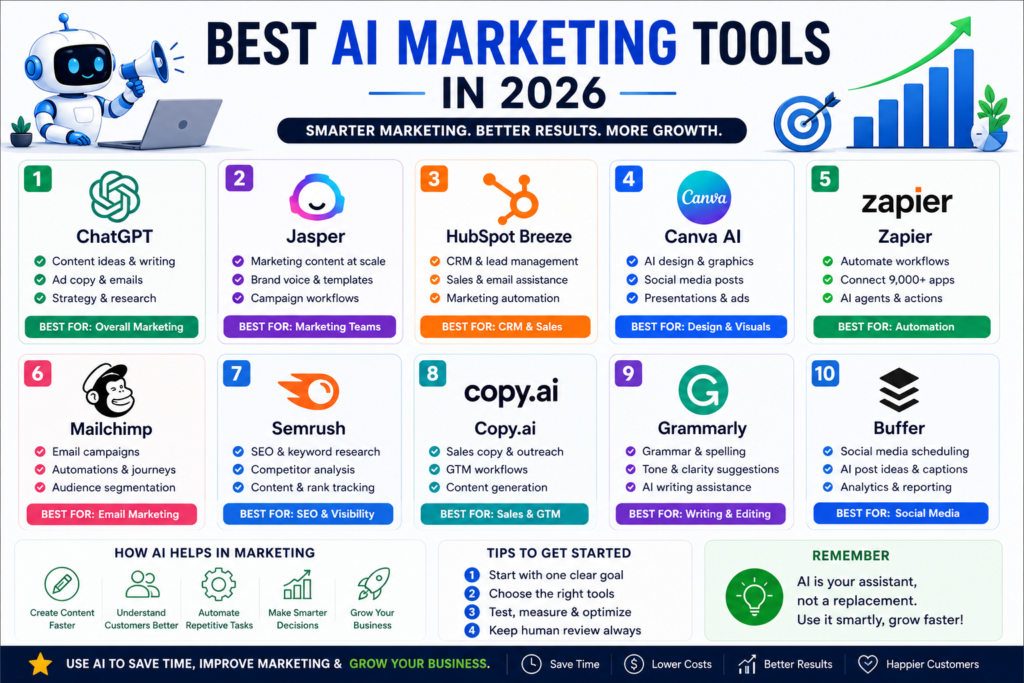
The best ai marketing tools 2026 are ChatGPT, Jasper, HubSpot Breeze, Canva AI, Zapier, Mailchimp, Semrush, Copy.ai, Grammarly, and Buffer. ChatGPT is best overall, Jasper is best for marketing teams, HubSpot Breeze is best for CRM, Canva is best for design, and Zapier is best for automation.
The best ai marketing tools 2026 are not just for big companies anymore.
Small businesses, freelancers, bloggers, ecommerce stores, agencies, and local service brands can now use AI to create content, write emails, generate ad copy, design graphics, automate workflows, improve SEO, manage leads, and understand customer data faster.
Honestly, this is a big shift.
A few years ago, AI marketing felt experimental. Now, it feels practical. You can use one tool to draft a blog post, another to design social graphics, another to automate follow-ups, and another to track SEO or AI search visibility.
Here is the thing. AI will not magically make bad marketing good. If your offer is weak, your website is confusing, or your audience is wrong, AI will not fix everything.
But AI can help you move faster.
It can help you publish more consistently. It can help you test ideas. It can help small teams do work that used to need a bigger budget.
So in this guide, I’ll keep it simple. These are the AI marketing tools that are actually useful in 2026.
Not every AI tool is worth using for marketing.
Some tools look impressive but do not save real time. Some create generic content. Some are too expensive for small businesses. And some are built for large teams, not everyday marketers.
A good AI marketing tool should reduce repetitive work.
That could mean:
In my experience, the best AI tool is not always the most advanced one. It is the one you actually use every week.
This matters a lot.
If your business already uses HubSpot, HubSpot Breeze makes sense.
If your team runs on Google Docs and Gmail, Gemini or ChatGPT may fit better.
If your marketing is social-heavy, Buffer or Canva may help more.
If your issue is automation, Zapier is more useful than another writing tool.
Do not buy AI tools just because they are popular.
Buy tools that solve your current marketing bottleneck.
This may sound strange, but it is important.
A good AI marketing tool should help you create faster, not publish blindly.
AI can make mistakes. It can use generic language. It can miss your brand voice. It can create content that sounds fine but says nothing new.
So the best workflow is simple:
AI drafts. Human edits. Business publishes.
That is how you get speed and quality together.
Here are the best tools I would consider for marketing in 2026.
ChatGPT is the best all-round AI marketing assistant.
You can use it for content planning, blog outlines, ad copy, email drafts, customer research, sales scripts, landing page copy, social media ideas, and campaign planning.
ChatGPT plans include free and paid options, while OpenAI lists Plus, Pro, Business, and Enterprise for users who need more access and features. ChatGPT Plus is listed at $20/month.
Best for:
Honestly, if you only choose one AI marketing tool, start with ChatGPT.
It is flexible. It is easy to use. And it works for almost every marketing task.
Jasper is built specifically for marketing.
That makes it different from general AI chatbots. Jasper focuses on brand voice, campaign workflows, marketing content, and AI agents for end-to-end marketing work. Its pricing page mentions Pro and Business plans, plus a 7-day free trial for Pro.
Best for:
Jasper may be too much for a beginner blogger.
But for agencies, content teams, and brands that need consistent marketing output, it is a strong tool.
HubSpot Breeze is best if your marketing is connected to sales and customer data.
HubSpot says Breeze is its collection of AI tools and agents built into the customer platform to help marketing, sales, and service teams get more done. HubSpot also has Breeze AI Agents for automating marketing, sales, and service tasks.
Best for:
This is useful because marketing does not stop after someone fills out a form.
You still need to follow up, organize leads, answer questions, and move people toward buying.
HubSpot Breeze helps when your customer data already lives in HubSpot.
Canva AI is one of the easiest tools for marketing visuals.
You can use Canva for social posts, flyers, presentations, ads, YouTube thumbnails, brand graphics, email banners, and simple videos. Canva’s pricing page says its AI tools include features like Canva AI, Translate, Magic Write, and other AI design tools depending on the plan.
Best for:
The good news is that you do not need to be a designer.
Canva helps small teams make marketing look cleaner and more professional.
Zapier is best for connecting your marketing tools.
It helps you automate workflows between apps like Gmail, Google Sheets, HubSpot, Mailchimp, Slack, Shopify, Notion, Typeform, and thousands more.
Zapier says it helps users build and scale AI workflows and agents across 9,000+ apps, and its AI page says users can connect 400+ AI tools to 9,000+ everyday apps.
Best for:
For example, you can set up:
Zapier is not flashy. But it saves real time.
Mailchimp is still one of the most popular tools for email marketing.
It helps businesses create newsletters, automations, customer journeys, signup forms, audience segments, and promotional campaigns. Mailchimp’s pricing page lists generative AI features, actionable insights, enhanced automations, and custom-coded email options across its marketing plans.
Best for:
Email is still one of the most valuable marketing channels.
AI can help you write subject lines, draft emails, personalize content, and improve campaign ideas faster.
Semrush is one of the strongest tools for SEO and search visibility.
Semrush says its platform helps brands grow and measure visibility across AI search, SEO, PPC, social, and more. It is useful for keyword research, competitor analysis, content planning, site audits, backlinks, PPC research, and brand visibility.
Best for:
If your marketing depends on Google traffic, Semrush is worth considering.
It is not the cheapest tool, but it is powerful for serious SEO work.
Copy.ai is useful for marketing and sales teams that need go-to-market workflows.
Copy.ai describes itself as a GTM AI platform, and its pricing page says workflows combine research, content generation, and tool integrations to codify business processes like account planning or SEO article creation.
Best for:
Copy.ai is not just a basic copywriting tool anymore.
It is more useful for teams that need repeatable sales and marketing workflows.
Grammarly is best for improving writing quality.
It helps with grammar, clarity, tone, rewriting, and AI writing guidance across apps and websites. Grammarly says it provides personalized AI guidance and text generation, while Grammarly Business focuses on helping teams communicate effectively with privacy and security controls.
Best for:
Small mistakes can hurt trust.
Grammarly helps make marketing copy cleaner before it goes live.
Buffer is a good choice if your marketing is social-media focused.
Buffer says it helps users create, organize, and repurpose content for any channel, and its AI Assistant helps brainstorm ideas, rewrite content, and craft platform-specific posts.
Best for:
If Hootsuite feels too expensive or complex, Buffer can be a simpler option.
It is especially good for freelancers, creators, and small businesses.
| Tool | Best For | Free Plan | Best Marketing Use |
|---|---|---|---|
| ChatGPT | Overall AI marketing | Yes | Content, strategy, emails, ads |
| Jasper | Marketing teams | Trial | Campaigns and brand voice |
| HubSpot Breeze | CRM and sales marketing | Yes / paid features | Leads, CRM, sales workflows |
| Canva AI | Design | Yes | Social graphics, ads, visuals |
| Zapier | Automation | Yes | App workflows and AI agents |
| Mailchimp | Email marketing | Yes / paid plans | Newsletters and automations |
| Semrush | SEO and visibility | Trial / paid | SEO, PPC, competitor research |
| Copy.ai | GTM workflows | Paid/team focused | Sales and marketing workflows |
| Grammarly | Copy editing | Yes | Tone, grammar, clarity |
| Buffer | Social media | Yes / paid plans | Scheduling and social captions |
AI marketing tools can help small teams move faster.
They can:
In my experience, the biggest benefit is consistency.
Most businesses do not fail at marketing because they have no ideas. They fail because they stop posting, stop following up, or stop testing.
AI helps keep momentum.
AI marketing tools also have problems.
They can:
Here is the thing.
AI marketing still needs a human brain.
You need to choose the right offer, understand the customer, edit the message, and check the final output.
Small businesses should use AI marketing tools because they usually have limited time and budget.
Best starting stack:
That is enough for many small businesses.
Freelancers can use AI for proposals, outreach, LinkedIn posts, content calendars, and client communication.
Best tools:
The goal is simple: look professional and save time.
Marketing teams need stronger workflows.
Best tools:
Agencies especially need consistency. AI can help create repeatable systems for research, content, reporting, and campaign planning.
Ecommerce brands can use AI for product descriptions, email campaigns, ads, social content, and customer segmentation.
Best tools:
For ecommerce, the biggest wins usually come from better email marketing, faster product copy, and consistent social content.
The best AI marketing tools in 2026 are ChatGPT, Jasper, HubSpot Breeze, Canva AI, Zapier, Mailchimp, Semrush, Copy.ai, Grammarly, and Buffer.
ChatGPT is the best free AI marketing tool for most users because it can help with content ideas, emails, ad copy, social captions, marketing plans, and customer research.
Buffer is great for simple social scheduling and AI-assisted captions. Canva AI is best for social media graphics. Hootsuite’s OwlyWriter AI is another strong option for teams that need content ideas and captions at scale.
Semrush is one of the best AI marketing tools for SEO because it supports keyword research, content planning, competitor analysis, PPC insights, and visibility tracking across search channels.
No, AI should not fully replace marketers. AI can draft, organize, automate, and analyze. But marketers still need strategy, creativity, customer understanding, brand judgment, and final editing.
The best ai marketing tools 2026 depend on your business.
But here is my honest recommendation.
Start with ChatGPT if you want one flexible tool for content, ideas, emails, ads, and strategy
.
Use Canva AI if you need better visuals.
Use Mailchimp if email marketing matters.
Use Zapier if repetitive work is slowing you down.
Use HubSpot Breeze if your marketing is tied to CRM and sales.
Use Semrush if SEO is a major growth channel.
Use Jasper or Copy.ai if you run a serious marketing team and need repeatable workflows.
And use Grammarly before publishing anything important.
My advice is simple. Don’t buy every tool at once. Pick one writing tool, one design tool, and one automation or CRM tool. Use them for real marketing tasks for one week.
If they save time and improve output, keep them.
If not, move on.
For more practical guides like this ai marketing tools 2026 article, keep reading AI Daily Tool for honest AI tool reviews, beginner-friendly comparisons, and real-world marketing recommendations.
Best AI Tools for LinkedIn Creators 2026: Write Better Posts, Grow Your Brand, and Save Time...
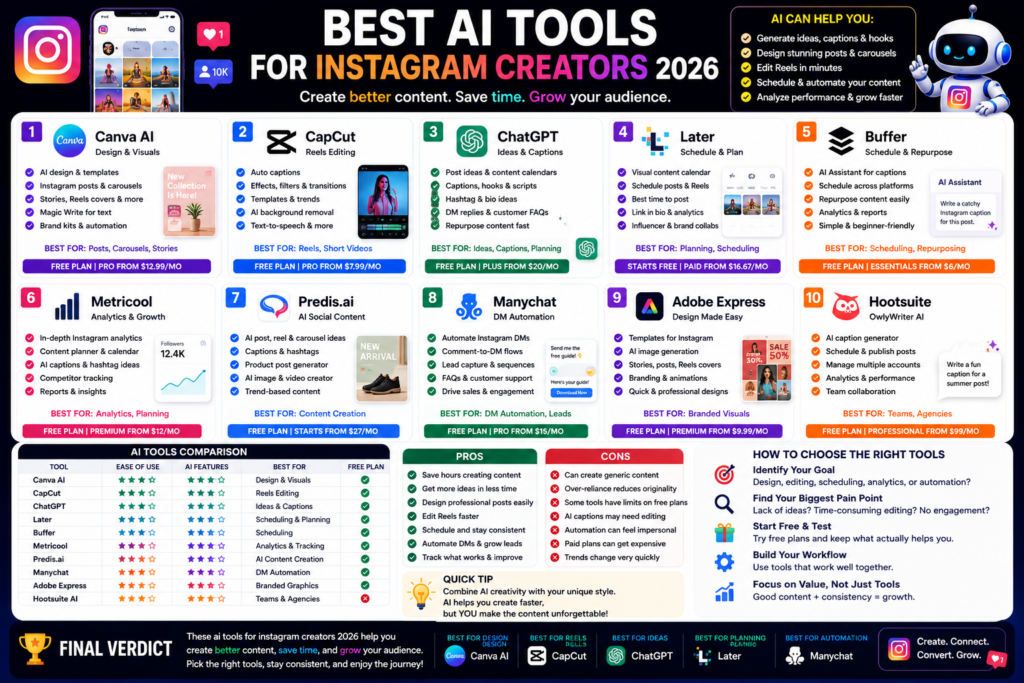
Best AI Tools for Instagram Creators 2026: Create Better Posts, Reels, and Carousels Faster Quick Answer:...
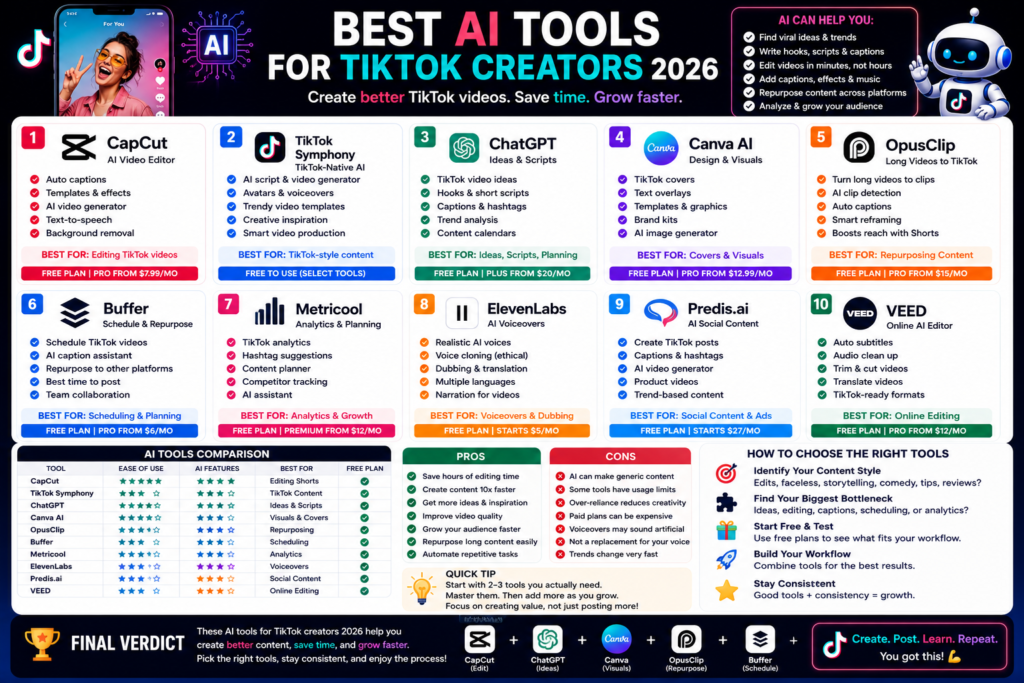
Best AI Tools for TikTok Creators 2026: Create Faster, Edit Smarter, and Grow Your Audience Quick...
Leave a Comment