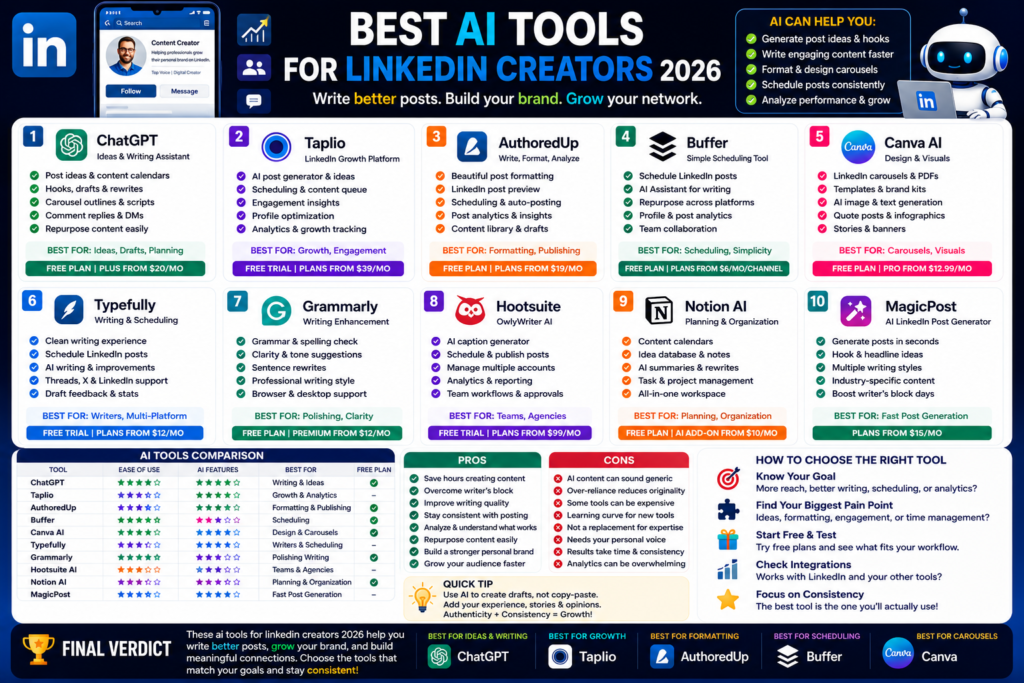
Best AI Tools for LinkedIn Creators 2026
Best AI Tools for LinkedIn Creators 2026: Write Better Posts, Grow Your Brand, and Save Time...
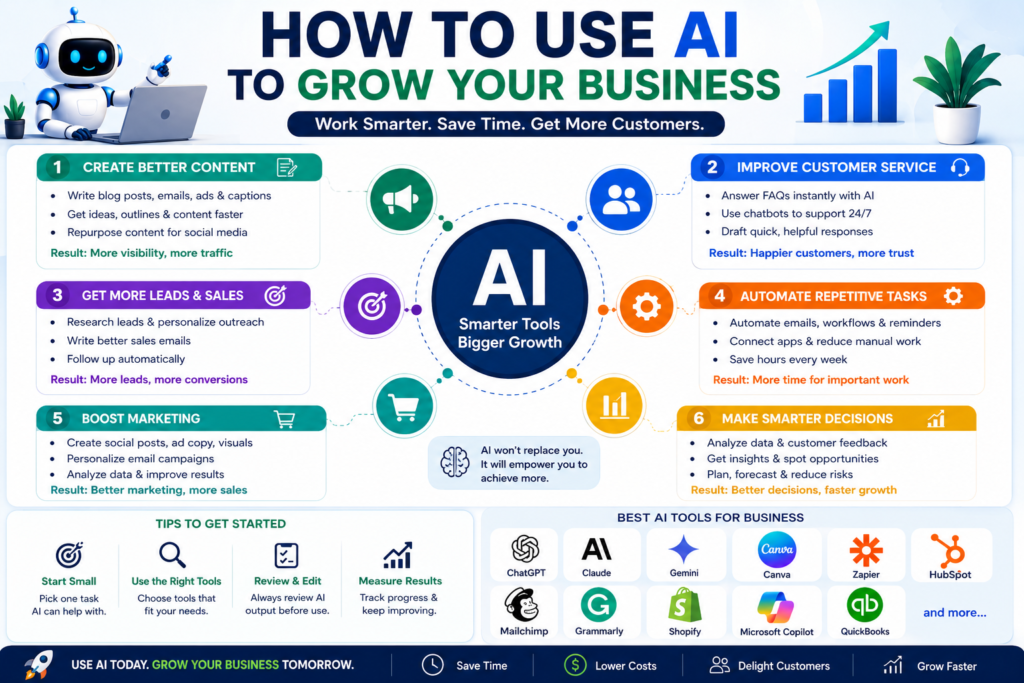
Quick Answer:
The best way to use AI to grow business is to start with simple tasks: content creation, customer support, lead follow-ups, email marketing, sales research, automation, and reporting. Don’t try to automate everything at once. Pick one business problem, use AI to save time, then build from there.
If you want to use AI to grow business in 2026, the good news is simple.
You do not need to be a tech expert.
You do not need a huge budget.
And you do not need to replace your whole team with robots.
Honestly, that is where many business owners get confused. They think AI means complex software, expensive consultants, or some futuristic system that only big companies can use.
That is not true anymore.
AI can help small businesses write faster, respond to customers quicker, create content, automate repetitive tasks, organize leads, understand data, and make better marketing decisions.
McKinsey’s 2025 global AI survey found that 88% of respondents said their organizations were using AI in at least one business function, up from 78% the year before. That tells us one thing clearly: AI is becoming normal in business, not optional.
Here is the thing.
AI will not fix a weak offer, bad service, or poor customer experience. But it can help a good business move faster.
And speed matters.
Before you open ten AI tools, stop for a minute.
Ask yourself one question:
What do I actually want AI to improve?
That question matters because random AI use creates random results.
Do not start with “I want to use AI everywhere.”
Start smaller.
For example:
In my experience, AI works best when you give it a clear job.
Bad goal:
“Use AI in my business.”
Better goal:
“Use AI to reply to customer enquiries 50% faster.”
That is specific. You can measure it.
Once you know the goal, choosing tools becomes easier.
If your problem is content, use ChatGPT, Claude, Canva, or Jasper.
If your problem is automation, use Zapier.
If your problem is ecommerce, use Shopify Magic.
If your problem is CRM and leads, use HubSpot Breeze.
If your problem is emails, use Mailchimp, Grammarly, or ChatGPT.
The tool should follow the business problem, not the other way around.
Marketing is one of the easiest places to start with AI.
Most small businesses need content, but they do not always have time to create it consistently.
AI can help with that.
AI can help you create blog outlines, title ideas, meta descriptions, FAQs, content briefs, and first drafts.
For example, a local service business can use AI to create blog ideas like:
But here is the thing.
Do not publish raw AI content.
Add your real experience, examples, client stories, screenshots, local details, and honest opinions. That is what makes content useful.
AI gives you the structure. You add the trust.
AI is also useful for social media.
You can ask it to create:
Honestly, this can save a lot of time.
A business owner can turn one blog post into ten social media posts using AI.
That is smart.
You are not creating from zero every day. You are repurposing better.
AI can also help with visuals.
Canva AI is great for social media designs, flyers, presentations, posters, and quick marketing graphics. Canva’s AI tools are included across its design platform depending on plan and feature access.
You can use AI to create:
The goal is not to become a designer overnight.
The goal is to make your business look professional faster.
Sales is another area where AI can help a lot.
Many businesses lose money not because they lack leads, but because they follow up too slowly.
AI can help you write better sales emails, follow-up messages, proposals, and call scripts.
For example, you can ask:
“Write a friendly follow-up email for a client who asked for a quote but has not replied in five days.”
Or:
“Create a short sales message for a small business owner who needs website redesign services.”
This is where AI is very practical.
It helps you respond faster without sounding too pushy.
AI can also help with lead research.
You can use AI to summarize a company’s website, understand its services, find pain points, and create a personalized outreach message.
This is much better than sending generic messages.
For example:
“Based on this company’s website, suggest three ways my SEO service could help them.”
That gives you a better starting point.
If you use HubSpot, AI can help inside your sales and customer workflow.
HubSpot says Breeze is its collection of AI tools built into its customer platform to help marketing, sales, and service teams get more done.
HubSpot also says Breeze can support tasks like completing work, creating content, finding information, and automating workflows inside HubSpot.
For a small business, this can help with:
The best part is that it works inside a system many businesses already use.
This is where AI can quietly save hours.
Repetitive work kills productivity.
AI automation helps your systems do more without you manually clicking everything.
Zapier is one of the best tools for this.
Zapier says it helps users build and scale AI workflows and agents across 9,000+ apps, with no code required.
That means you can connect tools like Gmail, Google Sheets, Slack, HubSpot, Shopify, Mailchimp, Trello, Notion, and many more.
Simple automation examples:
| Business Task | AI Automation Idea |
|---|---|
| New website enquiry | Add lead to CRM and send notification |
| New customer order | Send thank-you email |
| New appointment booked | Add to calendar and message team |
| New support request | Create ticket and summarize issue |
| New form submission | Add contact to email list |
| New invoice paid | Update spreadsheet and notify owner |
These are small things.
But small things add up.
Zapier explains AI business automation as adding artificial intelligence into workflows so systems can do more than follow rigid rules.
That is important.
Old automation says: “If this happens, do that.”
AI automation can say: “If this customer message comes in, summarize it, detect urgency, create a task, and draft a reply.”
That is much more useful.
Here is my honest advice.
Do not automate messy processes.
First, fix the process.
Then automate it.
If your sales follow-up system is unclear, AI will only make the confusion faster.
Start with one clean workflow. Test it. Then expand.
Customer service is one of the best ways to use AI to grow a business.
Why?
Because faster replies can mean happier customers.
AI can help you reply to common questions.
For example:
You can use ChatGPT or Claude to create professional reply templates.
Then your team can edit and send them.
This keeps your tone consistent.
AI can help turn your existing customer questions into help articles.
For example:
This reduces repeated questions.
And customers like fast answers.
Some platforms now offer AI agents for customer service.
HubSpot says Breeze Agents can handle time-consuming tasks across marketing, sales, and customer service while teams focus on strategy.
That sounds powerful.
But be careful.
For sensitive issues, refunds, complaints, legal questions, or angry customers, keep a human involved.
AI should support customer service, not damage trust.
If you run an online store, AI can help in many ways.
Writing product descriptions takes time.
AI can help create descriptions that are clear, benefit-focused, and easier to read.
You can ask:
“Write a product description for this handmade leather wallet. Make it simple, premium, and under 120 words.”
Then edit it with your brand voice.
AI can also help with ecommerce emails:
This is useful because email still brings repeat sales.
If you use Shopify, Shopify Magic is worth trying.
Shopify says Shopify Magic is a suite of free AI-powered features integrated across Shopify’s products and workflows to help users start, run, and grow their business. It supports store building, marketing, customer support, and back-office tasks.
This is useful because it works inside the ecommerce platform.
You do not need to copy everything between tools.
AI is not only for writing.
It can also help you think.
You can paste reviews, survey answers, support messages, or customer comments into AI and ask:
That is valuable.
Customer language helps you write better ads, landing pages, emails, and product descriptions.
AI can help summarize:
For small business owners, this is helpful because data can feel overwhelming.
AI turns messy information into clearer points.
You can ask AI to create step-by-step plans.
For example:
“Create a 30-day marketing plan for a small web design agency with a $500 monthly budget.”
Or:
“Create a weekly content plan for a local locksmith business.”
The plan will not be perfect. But it gives you a starting point.
That is often enough to take action.
| Business Area | How AI Helps | Best Tools to Try |
|---|---|---|
| Marketing | Blog posts, captions, ad copy, content ideas | ChatGPT, Claude, Canva |
| Sales | Follow-ups, proposals, lead research | ChatGPT, HubSpot Breeze |
| Automation | Connect apps and reduce manual work | Zapier |
| Customer Service | Reply templates, help articles, AI agents | ChatGPT, HubSpot Breeze |
| Ecommerce | Product descriptions, emails, store tasks | Shopify Magic, ChatGPT |
| Finance | Reports, summaries, expense insights | QuickBooks AI, ChatGPT |
| Planning | Strategy, content calendars, action plans | ChatGPT, Claude, Gemini |
AI can help your business grow by making work faster and easier.
Benefits include:
In my experience, the biggest benefit is speed.
AI helps you get from idea to action faster.
AI also has risks.
It can:
Here is the thing.
AI is powerful, but it still needs human judgment.
Do not let AI send important messages, publish legal content, or make financial decisions without review.
Small business owners should use AI because they often do too much alone.
AI can help with writing, customer support, marketing, planning, and admin.
Start with ChatGPT, Canva, and one automation tool.
That is enough at first.
Freelancers can use AI for proposals, client messages, project planning, outreach, and content.
This can save hours every week.
Use AI to look more professional and respond faster.
Ecommerce businesses can use AI for product pages, email marketing, customer service, ad copy, and store optimization.
Shopify users should start with Shopify Magic.
Agencies can use AI to speed up research, content planning, reporting, client communication, and internal workflows.
But they should build clear quality control.
AI drafts. Humans approve.
That is the safest workflow.
You can use AI to grow business by improving marketing, automating repetitive tasks, responding to customers faster, writing better sales messages, researching leads, creating content, and analyzing customer feedback.
ChatGPT is the best overall AI tool for business growth because it helps with writing, planning, research, customer replies, marketing, and productivity. Zapier is best for automation, Canva is best for design, and HubSpot Breeze is useful for CRM and sales.
Yes, AI can help small businesses get more customers by improving content marketing, email campaigns, ad copy, lead follow-up, customer research, and social media consistency.
Not always. Many AI tools have free or affordable plans. Start with free versions of ChatGPT, Canva, Grammarly, Zapier, or built-in tools like Shopify Magic if you already use Shopify.
No, not completely. AI can reduce repetitive work and help people work faster, but it still needs human review, creativity, strategy, and customer understanding.
The smartest way to use AI to grow business is to start small.
Do not chase every new tool.
Do not automate everything overnight.
And do not trust AI blindly.
Pick one business area where you waste time every week. Maybe it is customer replies. Maybe it is social media. Maybe it is lead follow-up. Maybe it is product descriptions.
Use AI there first.
Then measure the result.
Did you save time? Did you reply faster? Did you publish more content? Did more leads get followed up? Did your team feel less stressed?
That is what matters.
My honest advice is simple. Use AI like a smart assistant, not a magic solution.
Let AI draft, summarize, organize, and automate. But keep the final judgment human.
For more practical guides like this use ai to grow business article, keep reading AI Daily Tool for simple AI reviews, tool comparisons, and real-world business tips.
Best AI Tools for LinkedIn Creators 2026: Write Better Posts, Grow Your Brand, and Save Time...
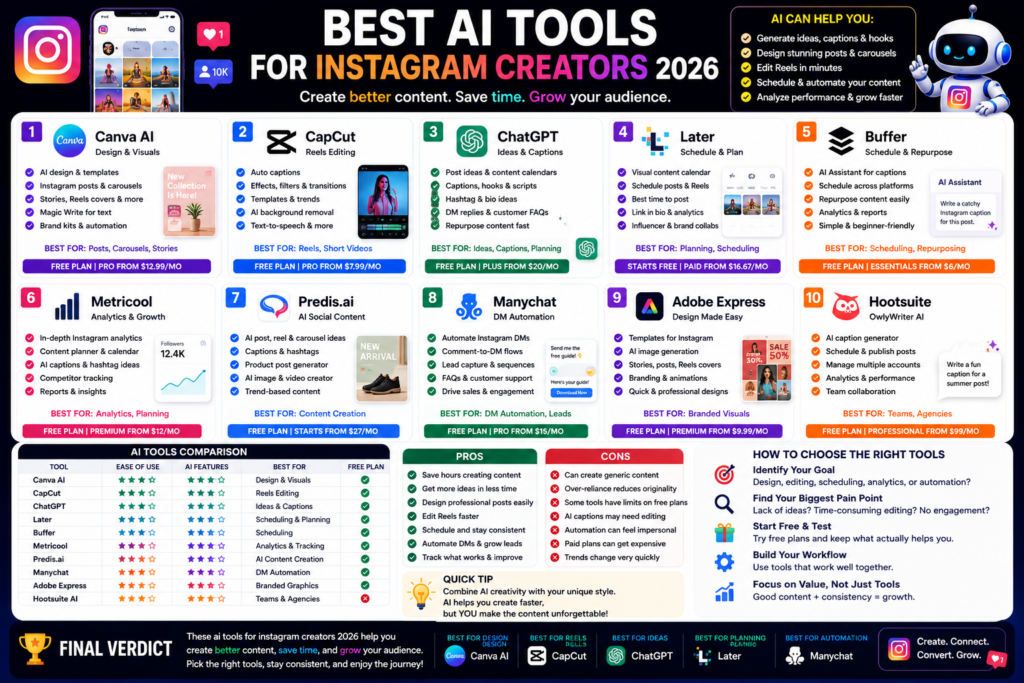
Best AI Tools for Instagram Creators 2026: Create Better Posts, Reels, and Carousels Faster Quick Answer:...
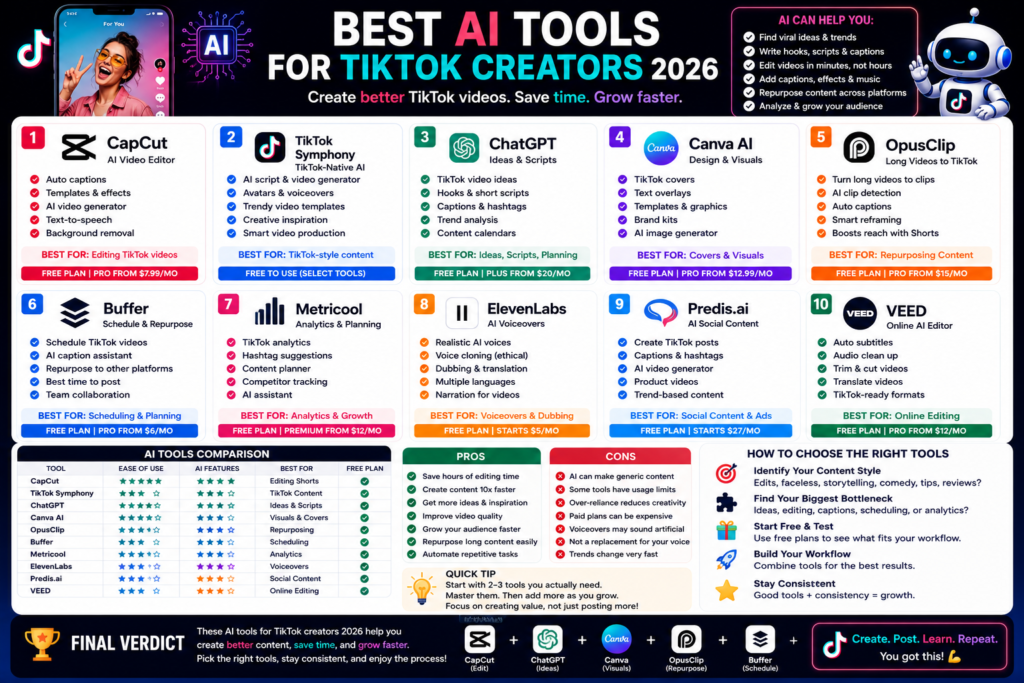
Best AI Tools for TikTok Creators 2026: Create Faster, Edit Smarter, and Grow Your Audience Quick...
Leave a Comment